
This is my latest article for Evangelicals Now…they have entitled it “The UK Church in Crisis: seeing the whole picture” – I prefer my original title ‘the Whole of the Moon”…not least because I was not claiming to see the whole picture! You can read the original here
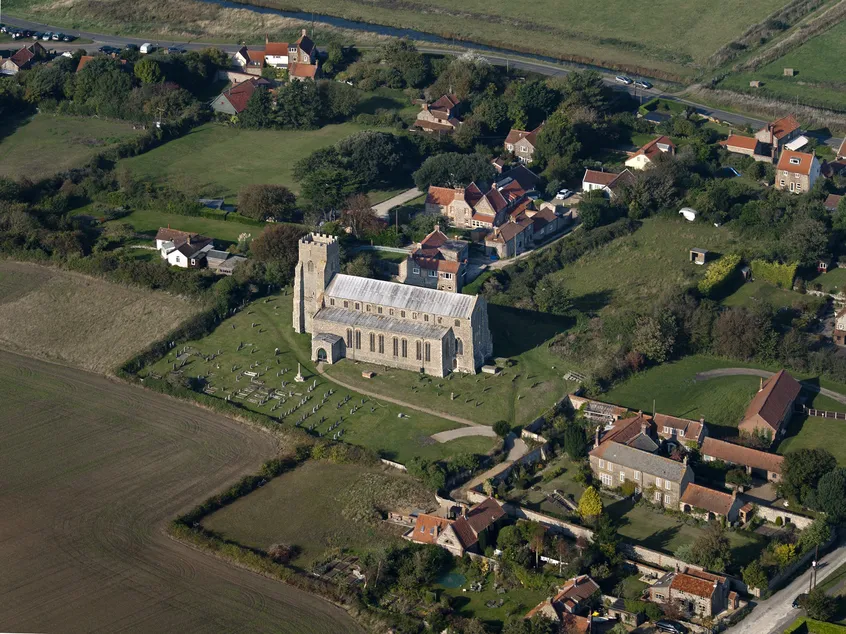 Aerial view of Salthouse church in Norfolk UK. Source: Flickr | John Fielding
‘I saw the Crescent, you saw the whole of the Moon,’ sang the Scottish band, The Waterboys in 1985. It’s a catchy tune with significant words.
The phrase came to mind as I reflected on the state of the Church in the UK in general, and in Scotland in particular. Although I am now in Australia my heart is still in the Highlands, and bleeds for Scotland and the UK – like Paul ‘I have great sorrow and unceasing anguish in my heart’ (Romans 9:2) as I reflect on what has happened and is happening to my own people.
Zooming in: change is possible
Sometimes when you are closely involved you are too close to see the wood for the trees. When I ministered in Scotland (for 33 years) I tried to occasionally take a helicopter view of church and society. To be honest I did not like what I saw and what the leadership in the Church of Scotland called ‘the trajectory’. To my mind it was like watching a train wreck in slow motion – not just in the denomination of the Church of Scotland, which has now collapsed into insignificance, but also in other areas of the Church, including my own denomination, the Free Church of Scotland.
 At the turn of the century there were a handful of us who came to the conclusion that unless the Free Church changed, within a decade it would have passed the point of no return. In particular I thought that we needed to change our form of worship (we were A cappella psalm singing only), our financial structures, our college and our geographical centre (we were largely Highlands and Islands based.
In the providence of God, by 2010 all of these had significantly changed. The Free Church now sings psalms, hymns and spiritual songs, the finance is less centralised and congregations less dependent on subsidies, the Free Church College has become Edinburgh Theological Seminary, and the Church while declining in its heartlands has grown through church planting in the lowlands and cities (and through some transfers from the Church of Scotland). For example, when I went to Dundee in 1992 there were less than 100 people attending any Free Church in the whole Tayside and North East Fife area. When I left in 2019 there were over 1,000.
In Edinburgh we were considering reducing the number of churches from three to two – now there are seven with more being planned.
Zooming out: a ‘perilous’ situation
But… that’s the crescent. What is the whole of the moon? My concern is that whilst the lifeboat may be getting a bit bigger, the Titanic is still sinking. The Church of Christ in Scotland – whatever denomination and including the Free Church – is still in a perilous situation. It reminds me of a Baptist church in one city centre where there was a moderately large and lively congregation with a good number of students and young urban professionals. It all seemed really healthy – until you realised that this church was in effect an amalgamation of several churches from the suburbs and housing estates. That story can be repeated in many areas and denominations.
I used to argue in 2019 that if I could snap my fingers and create a church with 100 people, I would need 7,000 such churches to get back to the basic church attendance/connection that existed in Scotland when I began my ministry in 1986!
With all our plans, strategies, new ministries, training, ‘visions’, centres of ministry, is there a danger we are just rearranging deckchairs on the Titanic? Or to put it another way – what if most of our strategies are really aimed at getting as large a slice of possible of an ever-decreasing evangelical pie? Two significant influences on the UK church have been US evangelicalism (in all its forms) and the UK public school ethos endemic in much of the leadership.
Two significant but ‘harmful’ influences on strategy
What if the influence of US evangelicalism does as much harm as good? In an internet social media world, which is often dominated by the US with its enormous resources, it is little wonder that drowning men clutch for the straws offered from the US. What if the corporate, networked model does not really suit the spread of the gospel in the UK? What if the top-down strategy – reach the city centres, the academic elites and the moneyed first – has not resulted in any trickle down?
And what if the ‘old boy network’ has just become ever more incestuous and irrelevant? A few years ago, I was at a gathering of several evangelical leaders in the UK – with two exceptions (the Scotsman and the Welshman) – no one questioned the strategy of reaching the 5% in order to reach the 95%.
The trouble is that in seeking a seat at the top table in society, we have been too scared to offend those who control that table. We have adopted the cultural values in public society, while in private society (i.e. our own closed church clubs) we still speak the radical gospel. But when the culture says ‘jump’ we just ask, ‘how high’? And lump those who dare to question with the eccentrics, the extremists and the egotists.
With all our plans, strategies, new ministries… is there a danger we are just rearranging deckchairs on the Titanic?
“Where you have a church, there you have a school ” (John Knox)
I can think of several areas where we have failed to grasp what is happening until it was too late. A key one is in the area of education. In Scotland the Protestant churches handed their schools over to the State in the 1872 education act on the condition that they would continue to remain Christian schools. That condition has long been breached – now in many areas we are sending our children to schools to be taught the bad and the ugly – paganism, progressivism, critical race theory and all forms of anti-Christian ideology – along with the good. Some of us tried to warn about this for decades and get the church to prepare for it… but we were so enamoured with crumbs from the secular masters table (school chaplaincies, formal religious recognition, university accreditation and even being allowed SU clubs), that we forgot our own Christian educational heritage. We should have been preparing for more Christian schools and even a Christian university. Now we act surprised that so many of our young people have turned away from the faith. And we have nothing to offer them.
Played and Misled
Just one more example of how this works. Many of the evangelicals within the Church of Scotland were misled. They thought that they were close to being the major force in the church. They were offered seats on important committees (but it was always a minority) and even made moderators – but all on the condition that they played the game, accepted the rules and did not rock the boat. Indeed, their purpose was simply just to keep other evangelicals on board, rather than change the system, or reform the Church. Those of us (within and without the Church of Scotland) who warned that this was happening were ridiculed as ridiculous, divisive and dangerous. Even our friends wanted us to tone it down. We were sidelined. And watched from those sidelines as the church disintegrated before our eyes – to the extent that some evangelicals were even honoured by the world for facilitating the LGBT ideology within the Church!
Mike Scott, the writer of The Whole of the Moon, stated in an interview with the Guardian: ‘The Whole of the Moon is about someone like CS Lewis, who seemed to see so much and explore issues much more deeply than most people, or it could be about a Jimi Hendrix-type person who comes “‘like a comet, blazing your trail” and is gone too soon, but it’s not specifically about anyone’.
Until we see the whole of the moon, I suspect we won’t have the insight, nerve or courage to deal with the major cultural and societal waters the church is swimming in. Until we get a few comet trail blazing people (like John Knox ‘give me Scotland or I die’), I suspect that many of us will just become deck chair arrangers…
Reformation will only come after renewal – renewal after repentance. Let it begin with us.
David Robertson, is the minster of Scots Kirk Presbyterian Church, Newcastle NSW and blogs at http://www.theweeflea.com
What’s Gone Wrong? The State of the Church in Scotland today
Seeing-‘the whole of the moon’-calls to mind the solar system and the earth racing around the sun at 17 miles per second, plus 600mph rotation speed in Scotland. The ‘business model’ church and the ‘signs and wonders ‘church can be obsessed with money and supernatural signs. But is the church often lacking in terms of ability to point people to the 3 C’s: Creation-Conscience-Christ? Christ and conscience are pretty unavoidable. But do we all too often overlook the evidence for God in creation?
Was just preaching on that this morning!
Hills of the North rejoice has great words, especially the final line perhaps….
Agreed
I grew up in west-central Scotland in the 80s and 90s and was always amazed at what an incredibly godless place it seemed to be. I don’t mean “godless” as in people were incredibly wicked, I mean they were just virulently opposed to the idea of God. I never really understood why. When I moved down to England, I noticed the difference. With people down here you can at least have a conversation about it.
Thanks David.
Re. your ‘two significant influences on the UK Church’ where you mention ‘US evangelicalism’ and ‘public school ethos endemic in much of the leadership’
While readily acknowledging significant parts of Anglican evangelicalism in England has been shaped by people from public school networks, I have never seen it as a significant influence in Scotland. You may know differently but I don’t think there is that kind of network in Scotland.
I do think that there does seem to have been some significant tie-ups with US sources of funding in the last 10-20 years with some of the most significant church planting networks being funded through partnerships with US Churches, and increasingly employing salaried multi-staff teams through that. I am not persuaded is sustainable in a Scottish context. If our growth only comes in places with salaried staff and/or external funding, what happens in situations where neither are available or optional?
As for your comment on ‘trickle down’ church growth; I have never heard that phrase used specifically in the context in which you are employing it, but I have always suspected the concept was there – and it surely owes more to conservative economic thinking (where the phrase is normally used) than to Biblical mission and theology.
It will not surprise you to know that I think the story of Acts, and the history of revivals in Scotland, is nearly always the opposite of ‘Top-down’ – it is ‘bottom-up’. To whom was Jesus drawn? Who was it that heard his word ‘gladly’? Among what communities has revival broken out in our land in the past? We would do well to remember these things and seek the God who works consistently with his character. ‘Without me you can do nothing’ is both a promise and warning to us; the corollary of that might also be that ‘with me all things are possible’
Thanks David – I was writing about the whole UK but accept your comment on Scotland….although I do think that various networks do have a significant influence in Scotland – particularly with the demise of the Church of Scotland. I agree with the rest of your comments…
Could you point my to published sources on the state’s 1872 takeover of his education in Scotland? Please and thank you.
This article gives a list of sources…..also if you can get anything from Prof Lindsay Paterson – although I think his speciality is more the 1918 act. chrome-extension://efaidnbmnnnibpcajpcglclefindmkaj/https://eprints.gla.ac.uk/265060/3/265060.pdf