
This is my latest article on Christian Today – you can get the original here. This has taken me about three months to write as I have tried to work out what is going on….I hope it is helpful…
A word of caution about the ‘Quiet Revival’ in the UK

When I first began in ministry in the Scottish Highland village of Brora, we regularly received visitors who in response to the infamous 1967 Jean Darnall’s prophecy about ‘revival fire’ spreading from the Scottish Highlands to the whole of the UK, wanted to come and get a bit of the action.
Our small church was growing – and they believed we were one of the signs. To be honest they were at best a nuisance – at worst a hindrance.
Similarly, when I went to Dundee – to the centre of the Scottish revival in the 1830s and 40s, the church of Robert Murray McCheyne – we often got visitors who came on pilgrimage to our Protestant shrine, and who sometimes assured us that revival was coming.
Although the church grew significantly it was not revival. And again, the revivalists were usually more of a hindrance than a help.
I write this as someone who believes in, and longs for, real revival. Now that I am in Australia I am hearing yet again of revival in the UK. Watching from afar it is not easy to ascertain what is going on, but then distance – and experience – also gives a wider perspective which I hope will be helpful.
The reports emanating from the UK vary from cautious optimism to exultant. As an example of the latter, take this report from CBN in the US.
Numerous facts are poured out to show that ‘the quiet revival’ has arrived – not just in the UK but in the West in general. We are told that church attendance has increased over 50% in the past couple of years, with two million more people attending; that Bible sales in the US are up 22%; that 17,000 people were baptised into the Catholic church in France this Easter; that 66% of Americans have made a ‘meaningful commitment to Jesus’; that YouVersion’s Bible app and Alpha’s evangelism course are seeing record numbers; all of this is further evidenced by anecdotal evidence of more baptisms, conversions and packed churches.
Bobby Gruenewald, CEO of YouVersion, suggests that “while Christian revivals have happened throughout history, the data suggests that this revival could have an even further reaching impact. While previous revivals were localised to a particular town, region, or country, this Quiet Revival is clearly global. And where some previous momentum may have plateaued after a period of time, today’s revival shows no signs of slowing down.”
Let me first of all unpack some of this and add a note of cautious reality (hopefully not cynicism) – and then add a note of cautious optimism.
Firstly, there is no quiet revival – at least the quiet bit. This has to have been the most publicised, broadcast and commented on revival in history!
The claim that this is the biggest, best revival yet is hyperbolic wishful thinking. Previous revivals were not generally limited to a particular, town, region or country but often spread across borders – even in an age without mass media! For example, the revivals in Scotland in the mid-19th century were echoes of, and were themselves echoed in, the US. As for the impact, there is no question that the Reformation, the Disruption revivals in Scotland in 1843, the US Great Awakening, the Welsh Revival at the beginning of the 20th century, and the Hebridean Revival of the 1940s had impact that lasted decades and sometimes centuries. This current ‘revival’ is barely two years old.
What about the endlessly repeated assertion that church attendance is up by over 50%? It’s just not true. The reality is that 2,000 people out of 13,000 stated in a survey that they went to church at least once a month. This is higher than the previous survey, but it does not prove a 50% increase in attendance. Surely by now we have learned not to trust opinion polls – especially those commissioned by an organisation which has a vested interest in the outcome?
The Bible Society argues that YouGov is a reputable organisation which weights responders to filter out any bias. The problem is that a YouGov survey is not a census. It is filled out by those with sufficient interest to bother to fill out the forms and to self-report. I am a YouGov volunteer and regularly receive requests to fill out surveys. I have no interest in filling out a survey about golf, American politics or house prices in Wales! By definition those who fill out YouGov surveys are those who have signed up to do so – they are not representative of the whole population.
There is a further problem. What if they are not telling the truth? What if they really mean I would ‘like to go to church’ more than once a month? Or they consider watching a service online as being the equivalent of going to church? And anyway, why would someone going to church once a month indicate any sign of revival? I accept that there are comparative figures from a previous survey using the same methodology, but that only shows that there has been a change in the vibe of people who answer YouGov surveys.
A further difficulty is that the report states that both Church of England and Catholic churchgoers went up significantly between 2018 and 2024. Yet both these denominations have produced actual attendance figures which show a decline over that period. For example, in the Catholic Church in 2019 mass attendance figures were 829,000. In 2023 it was 555,000. In 2023 Church of England attendance was at 685,000. In 2019 it was 854,000. I am unsure why people are stating that this is a 50% increase. As Mark Twain (citing Disraeli) stated ‘there are lies, damn lies and statistics’.
Seventeen thousand people being baptised in the Catholic Church in France is not a sign of revival. It is at best a sign of renewed interest in some sections of the French population in Catholicism. But you need to take several giant leaps of (blind) faith to see this as evidence of biblical revival!
As for Barna’s assertion that 66% of Americans have ‘made a meaningful to commitment to Jesus’, it all depends on what you mean by meaningful. I recall doing Evangelism Explosion in Jackson, Mississippi where it appeared that the vast majority of people had ‘given their lives to Jesus’ – many several times! The prisons were full of ‘born agains’. Doing meaningful evangelism among people who have been told that they have already made meaningful commitments is really difficult. Give me pagans to evangelise any day!
The trouble is that the leaders of Christian ministries tend to talk up the ‘God is on the Move’ language, because their ministries depend on it. In an era of soundbites, fundraising, and a free for all in the market of Christian funding, shouting positive things loudly is at least as effective as warning everyone that the apocalypse is just around the corner!
So what is happening?
I think the evidence is pretty overwhelming that a cultural shift in some – not all – areas of the culture is happening. The impact of Jordan Peterson, Douglas Murray, Joe Rogan and other ‘conservative’ commentators has encouraged many to take a fresh look at the Bible. Maybe after all it is relevant?
There is a cultural shift towards Christianity among young people, and especially young men.
We should also be aware that a significant part of the increase is amongst ethnic minorities. For example, just before I left Scotland I was told of a significant number of new churches – which sounds like revival – but it turned out that these were all Nigerian churches. The Catholic cathedral in Dundee experienced a growth of 500 – the vast majority being Polish. It is a positive that many of the immigrants coming to the UK are Christian, but it is not revival.
Christianity is cool, Christianity is cultural, Christianity is conservative. I don’t think that any of that is wrong. But it ain’t revival. The Lord may use that and churches need to learn to surf the cultural waves, but let’s not get caught up in the hyperbole.
Natasha Moore writing for the Australian ABC on religion and ethics issues this warning: “On the more cynical end, as Christianity’s public image becomes less stodgy and more — dare I say — popular, churchgoing or reading the latest ‘it’ theologian may carry something with it that, in most of the West, Christianity hasn’t had for quite some time: social cachet. As one Silicon Valley entrepreneur puts it, ‘I guarantee you there are people that are leveraging Christianity to get closer to Peter Thiel’ — the billionaire tech venture capitalist who has been speaking openly about his evangelical faith for years.”
But what about all the anecdotes of conversions, baptisms and special meetings? For example, one newspaper article cites this as evidence for revival in Scotland: “In the year to Easter 2024, a small Baptist church on the Isle of Arran doubled in number, forcing a relocation to larger premises. Meanwhile, Skye Bible Church reported that 16 youngsters were added to the fledgling student union at Portree High School. In Pitlochry, a quarter of the local high school now attends church. And in the village of Kirkliston, 100 children and young people now attend the church’s various clubs and activities.” (Pitlochry by the way has a secondary high school of 130 – so we are talking about 35 young people attending church).
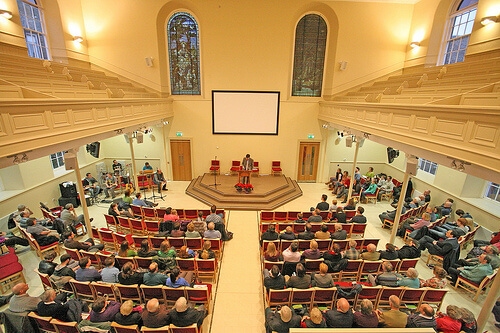 It has been ever thus. In my own experience I have seen one church go from 40 to 100. Another from seven to 250. When I became a Christian, 30 to 40 of my year at school came to our house over summer for bible study. This latter was probably the nearest to revival I have personally experienced, but it was almost destroyed by ‘revival watchers’ – similar to whale watchers and bird spotters, but more spiritual – who came and told us that ‘God had told them to come up and take control of this work of the Spirit’! I remember speaking at the Nicolson Institute in Stornoway to around 100 pupils. This was all wonderful – but it was not revival.
In fact, what people are calling ‘revival’ is to me just normal church life. Or at least it should be!
What is revival?
Ian Murray’s Revival and Revivalism is a helpful book on the historical basis of revival. In terms of the last revival in the UK, read Tom Lennie’s marvellous Glory in the Glen: A History of Evangelical Revivals in Scotland 1880–1940.
In summary real revival involves conversions, powerful preaching, prayer and repentance, and it results in moral and social reformation. But most of all, real revival is a lifting up of Jesus Christ, in the power of the Spirit, to the glory of the Father. In passing, I note that many of the commentaries I have watched and read are full of talk about Christianity, sociology, data, and the excitement of seeing something happening – but very little about Christ. He is too often used as spiritual punctuation or religious language.
Five principles
1. You don’t measure revival by data.
Numbering the Lord’s peoples hasn’t always worked out well for the church! Our society is obsessed by data. Data is the new gold – and data mining the new way to get rich – and spiritually poor. This is not to say that numbers don’t matter. The more on their way to heaven the merrier. But often God does work in ways that we cannot immediately quantify. In my first charge there was a wonderful Godly woman, Barbara– if we had prophetesses in the Free Church, she would have been one!
She once told me that they had been praying for revival for decades – at one point in a time of spiritual renewal they had all night prayer meetings. She was disappointed it hadn’t come – but then she had a revelation. It had! Hundreds in that small village had become believers, several had gone to serve the Lord as ministers and missionaries. If that had happened in 40 days the whole Christian world would have heard about it. But it had taken place over 40 years. A blink in the span of eternity – but an eternity in today’s instant media world.
2. You don’t have a quiet revival by shouting about it.
“This is what the Sovereign Lord, the Holy One of Israel, says: ‘In repentance and rest is your salvation, in quietness and trust is your strength, but you would have none of it'”(Isaiah 30:15).
3. You don’t have spiritual rebirth through a general belief in God.
It’s great that some people are having more positive attitudes to Christianity and that some have even become Theists and cultural Christians … but it ain’t enough.
“You believe that there is one God. Good! Even the demons believe that—and shudder” (James 2:19).
4. God is always at work.
Christianity is not ‘back’. It was never away. One of the reasons that I did not despair when the new atheists were riding high was because a) there was nothing really new about them and b) the Lord was continuing to work. Attacking God may have been the fashion in the coffee houses of Oxford, London and New York, but the Lord who worked in the midst of the evil Roman Empire, was well able to work in the modern West – even through Richard Dawkins! For example, I estimate that I, along with many others, were able to bring God’s Word to tens of thousands who otherwise would not have listened.
“So is my word that goes out from my mouth: It will not return to me empty, but will accomplish what I desire and achieve the purpose for which I sent it” (Isaiah 55:15).
5. God is sovereign.
He doesn’t need us – nor our culture warriors, strategists, spiritual influencers, bloggers, preachers, singers, experts, etc. He can, and does, use us. But He works out his plans according to His purposes. Belief in the sovereignty of God doesn’t hinder our evangelism – it liberates it.
“For I am with you, and no one is going to attack and harm you, because I have many people in this city” (Acts 18:10).
And it is precisely because I believe in the sovereignty of God that I cannot tell God what He should be doing, or even understand what He is doing. So, He may well be working through the not so quiet revival, or in spite of it. All I know is that I trust Him and that the gates of Hell cannot prevail against his Church. God wins. That’s enough for me …
David Robertson
P.S. As a good post-millennialist I also believe that there will be a great outpouring of the Spirit before Christ returns and that the earth will be filled with the knowledge of the glory of the Lord as the waters cover the sea (Isaiah 11:9) … but that’s another discussion!
amen!
Great article once again David and thanks for it.
Another revival here in Ulster happened in 1859 known locally by the same name ‘the Ulster revival’.
https://en.m.wikipedia.org/wiki/1859_Ulster_revival
There are many stories about what happened at the time such as pubs going out of business and workers returning stolen items from the Hartland and Wolff shipyard. Whether legend or truth I do not know. If truth great, maybe perhaps folklore. The Lord knows.
My own opinion is that we are in a period of a great falling away and no significant future revivals will occur. 2nd Thess 2.3 Matt 24.10 etc.
But I believe there are other types of revival. Take the story of Frank Jenner of Sydney Australia. He quietly over many years stood in George Street Sydney and stopped people to ask “Sir if you were to die tonight would you go to heaven or hell”? The story goes that countless 1000s were led to Christ through that one man asking that one question. Some of his converts went on to be missionaries.
https://youtu.be/9rm9btmJavU?si=5Ue7Dg9neEzQoT_7
Thanks again for the article.
Stephen Meharg.
Interesting! Thanks. I guess lots of past revival movements have been centred in para-Church or fringe groups. Mainstream praise, from central denominations, who cite positive statistics, stands in contrast to the hostility typically faced by lots of past revival groups.
David, thank you for your wise reflections.
I wonder if your reaction might be a little different if these recent observations were not named ‘revival’ but a trend or a change.
Throughout our lifetimes the graph of church attendance, Christian affiliation or belief in God has been on a steady downward trajectory. Some had calculated that if the rate of decline continued the church in the UK would no longer exist in a few years time.
I cannot help but feel a frisson of joy and hope that something has changed in the last five years. It is surely a remarkable change.
There have too been lots of anecdotal reports of record attendances at Easter services and as you reference, an increase in interest about Christ among the young especially men.
Let us hope and pray this may indeed be a true revival. Time will tell
Thank you, David, for a measured and wise appraisal of the situation. One of the problems is that we are, in the UK, in such a low place spiritually that we grab hold of anything that might indicate that things are not really as bad as we think they are, or that things are ‘turning a corner’. I welcome any and every indication of some growth or renewed interest in genuinely spiritual matters, but to call it ‘revival’ is erroneous and especially so when a lot of this supposed growth is seen in a non-Christian church like Roman Catholicism.
Thank goodness, as ever, for David Robertson! I comment as an English Baptist and he almost always gets it right! We long for true revival – and don’t want to dismiss what might be happening – but this note of caution is absolutely correct. “You don’t have a quiet revival by always shouting about it”!!! Of course, we rejoice in anything God is doing but from my reading of revival (just been reading Dr Lloyd-Jones’ account in a new book by Philip Eveson, of the 1904-05 Welsh revival, which did have its issues), I am not sure we can give what is happening that title.
As a good pre-millennialist I also believe that there will be a great outpouring of the Spirit before Christ returns and that the earth will be filled with the knowledge of the glory of the Lord as the waters cover the sea (Isaiah 11:9)
David
I wouldn’t disagree with a lot of what you say but there is something that is changing and prompting young folk with no previous church or Christian connection to enquire and to buy Bibles. We are seeing it in school groups and at church (of Scotland in the Greater Glasgow area!). The only Christian bookshop in Glasgow reports numbers of young people coming in to buy a Bible because they want to read it. So, something is afoot and I take it that it is the Holy Spirit at work. Not properly described in ‘revival’ terms but enough to be measurable and occurring in different parts of the country. After decades of decline, ‘Aslan is on the move’ is how I might best put it.
Hi David
I’ve heard you on your “Quantum” podcast and other places where you say the similar things. You are someone I admire, which is why I subscribe to your podcast. But I fear that you are a habitual cynic who has the ability to find the dark side of any story.
But, strangely enough, that’s why I listen to you – you find apparent warning lights where I’m not even looking. In every good family we need one person like you, someone willing to stand up and question the developing family position on any issue.
But still, I’d like to temper your cynicism by introducing you to the grey region of life where I think God’s people should live – healthy scepticism (not cynicism, which cannot be moved away from the negative) willing to move into the negative or the positive, all dependent on the insights we slowly discover. People who accept a more modest posture because we are so small, so limited.
We need to be careful about becoming people with an instinctive bent towards the negative interpretation of life. People who are always suspicious that if we believe too quickly we will be made to look like fools. A self-protective posture that keeps us safely and slowly riding on the back of Eeyore because we fear the exuberance and naïve posture that Pooh takes towards life.
Allow me to suggest a diagonalised (looking in both directions) epistemological posture to the events of life, one that I think does justice to our lives that are still being lived in a confusing fallen world, whilst always listening to a range of interpreters. This allows us to avoid the easy “black or white extremes” but rather we sit patiently in the uncomfortable centre of Biblical tension, even when it is the least popular option.
Sitting and listening, exploring and testing every interpretation, for a season, in the belief that with time we will come asymptotically closer to the truth, the place where God has been sitting for ages, quietly watching us and smiling as we get closer.
As I read your article the following thoughts came to mind:
1. Yes David, you’re right, we need to be careful. Our ancestors have made some grave errors seeing revival when actually nothing eventually appeared. But I would respond: but also beware of detecting a glorious aroma coming from the kitchen and immediately insisting that, “Its only old boot polish mixed with mouldy gravy. No banquet is being prepared because life is never that good.”
You see, the problem with being human is that we are trapped in the present looking back into the past (where you have minded your insights) and trying to imagine what may be coming from behind us, from the future.
Why not turn around and patiently analyse these shards of data coming our way whilst remaining cautiously hopeful because we know our history? What I call “living with reasonable hope in an age of corrosive cynicism”. At this early stage (a real revival will take us at least another 20 years to confirm, and even then you will probably doubt it) we’re only looking at 2-3 years of evidence.
2. Your response of instinctive doubt sounds wise, the sage stroking his beard because he’s seen it all before. But you haven’t. And that is the appropriate stance of modesty I’d like to remind you of. The 20-20 vision of the future taken by the historian needs to be questioned.
The past doesn’t determine the future. God can do a new thing; any time he wants. Our job is to humbly stand on the hill and look to the horizon. Is that little cloud going to grow into a rain-soaking cumulonimbus or will it be blown away? I’m just a viewer waiting to see what God may be doing. Elijah is behind me asking me to tell him if anything meaningful has yet appeared on the horizon. You are the onlooker next to me saying, “Tell Elijah he’s wasting his time. God rarely bothers to show up.”
3. Time bound human beings also need to humbly admit that we are still time bound, living as tiny particles swept along in a God directed flow of mission that He alone shapes and directs. When you write, “In summary real revival involves conversions, powerful preaching, prayer and repentance, and it results in moral and social reformation.”. Of course you are right.
But as you slam your gavel down before the court I would still wish to remind him of your time bound life. You neglect the fact that you are talking about a time-marinated series of slow appearing results. Results that may one day be written about by future historians. Results that may be happening even now, ones that we cannot yet see. Cautiously-assessed results because people are still watching.
Until then the sage sits back down again and strokes his beard as he tugs on Eeyore’s reins and declares that he will remain uninvolved until the results that may yet take decades to appear, start to appear right now. A naïve stance that insists that God pitches up immediately, instantly collapsing all of his long-term plans into one moment before your sceptical eyes.
4. How about living with what Puritans call, “healthy self-doubt”? Doubting even your doubts. Puritans took the damage of sin more seriously than you appear to do. It even corrodes our imaginations, our hopes and our dreams. Beware of its impact. Keep searching, keep praying and analysing whilst keeping your current assessment in the tentative basket, waiting for further time-bound slow appearing data.
I’m planning on going to the “Responding to The Rebirth” conference on 22nd of November 2025 at All Souls, Langham Place, wearing the above pair of lenses. It would be great if you could join me. Blessings Ian
After I quickly read your comment I was going to thank you for it as offering a different perspective. But having re-read it I cannot do so. In fact your comment is ironically one of the most cynical and dark I have ever read. You urge me to do what I have done in the article as if I have not done it. You want me to be cautious and to take time….which is precisely what I have done. The article itself is entitled ‘ a word of caution about the UK quiet revival’. I speak of ‘cautious optimism, warn against cynicism, use words like ‘may’ and ‘could’; and suggest that God ‘may well be working through the quiet revival’. So how did you manage to interpret that in the way that you do? What did you write about me as though I was saying the exact opposite?
1) I am not a habitual cynic who has the ability to find the dark side of any story. I used to be intimidated by this kind of judgemental statement from people who seem to think they can see into my heart. Please don’t do that. There is one criteria you should use to judge and that is truth. Is what I say true? I remember the same complaints about my comments on the Church of Scotland – ten years ago – or transgender. It’s too dark…cynical etc. The reality turned out to be far darker than I said. When I look at things biblically I suspect Elijah, Isaiah, David, Paul and Jesus would be also found guilty of seeing the dark side and being cynical. I am not a cynical person – and I don’t really think you are in a position to judge that. By the way for you to state that on the basis of this article on revival is somewhat absurd….the article is quite positive and hopeful. And yet somewhat cynically you manage to see cynicism and darkness within it.
2) I am not a person who takes an instinctive negative position on life. Of course my answering your accusations is difficult because it is like answering someone who accusses you of being proud. How do you answer without immediately proving them right (at least in their own minds)?!
3) I don’t think that God sits quietly and smiles as he waits for us to come to his position. He is way more proactive than that.
4) Your suggestion that we wait is both true and unnecessary. Because that is precisely what I was arguing in my article. We don’t know – so we wait and see. Even you hadn’t had such a dark and cynical view of both me and the article you would have seen that!
5) Try to avoid the judgementalism and cynicism that comes through in your post – like the snarky comment that even if revival is proved after 20 years ‘you will probably doubt it’.
6) Another example of that snarky and somewhat superior judgementalism is your claim that I portray myself like the wise sage stroking his beard, claiming I have seen it all before. I don’t and I’m not making that claim.
7) Its interesting that you portray yourself as the humble viewer waiting to see what God is doing, whilst I am the cynic telling Elijah that God rarely bothers to show up. Your humility shines through….!
8) Your comment about only eternity revealing things is true – but that again is precisely what I was saying. So it intrigues me that you write as though I was saying the opposite. Either you didn’t understand what I was saying or your cynicism about me has coloured your reading. I was not ‘slamming down my gavel’ (incidentally something you seem to have no problem doing with me and my article)…
9) I find the comment that I sit back and remain ‘uninvolved’ deeply ignorant and offensive. As someone who has been involved in outreach and evangelism for over 45 years it is breathtaking to me that you make that accusation. If I wanted to sit back and stay uninvolved I wouldn’t have written the article – which bitter experience has taught me – usually results in the kind of attack that you put forward.
10) I agree completely with what the Puritans called ‘healthy self doubt’. As someone who literally reads the Puritans every single day I know what their stance is. The irony to me is that you have written a comment which is precisely the opposite of theirs – affecting to know someone else’s heart, sitting in judgement upon someone else whilst decrying sitting in judgement, and expressing ‘healthy self doubt’ whilst at the same time writing with absolute certainty!
I won’t be going to the Responding to the Rebirth conference on 22nd November – because I live in Australia and as a Presbyterian minister I can’t afford to go back and forward to the UK. And I really would not want to see things through your lens – which I find dark and depressing and somewhat disingenous. And to be honest more than a little self-righteous. Forgive me for saying it – but perhaps you should learn to take the beam out of your own eye before you take the speck our of your brothers?
I wish you no harm. And I do pray that God will bless you. But next time try to avoid the cynicism you condemn – and try not to assume the worst of those you are writing about….
As someone who has written numerous articles on revival in recent years, I applaud your measured and extensive coverage of all the angles of what appears to be happening at present. Yes, there are ‘green shoots’, and that is to be celebrated. But it is far from being revival, and more like a cultural vibe shift. Your reference to numerous revivals of the past, and how they transformed culture, is a much needed corrective.
And I also applaud your proper use of scepticism, not cynicism as claimed by another here. Yours is the scepticism of the investigative reporter and the scientific researcher, digging into what’s happening to find why it’s happening. You and I have both encountered the opposite from cynics among the atheists in recent years, who use their cynicism as a protective shield against contradictions to their worldview. Scepticism is healthy. Cynicism is a mind virus.
Like you, I believe that there will be a final and unparalleled outpouring of revival prior to the return of Christ. I also believe that through the way God brings it about that it will lead to a situation where nobody will be able to sit on the fence and say, “Well, I believe in God, but…”. As a consequence people will either love God or hate Him.
But as you say, that’s another discussion!
Sitting in Oxford I don’t see a revival. No conversions this year, or people coming into church membership who aren’t transfer growth.
We have seen this in previous years, but only ones or twos.
There is a greater cultural openness to Christianity, as people stare into the abyss of what a world looks like without it. But I agree with David that this is not the same thing as a revival.
We do receive reports from Belfast City Mission in Ballybeen where the Gospel appears to be robustly preached, and there appears to be a wonderful reception by at least two solid ministries.