
This first appeared on my substack here….
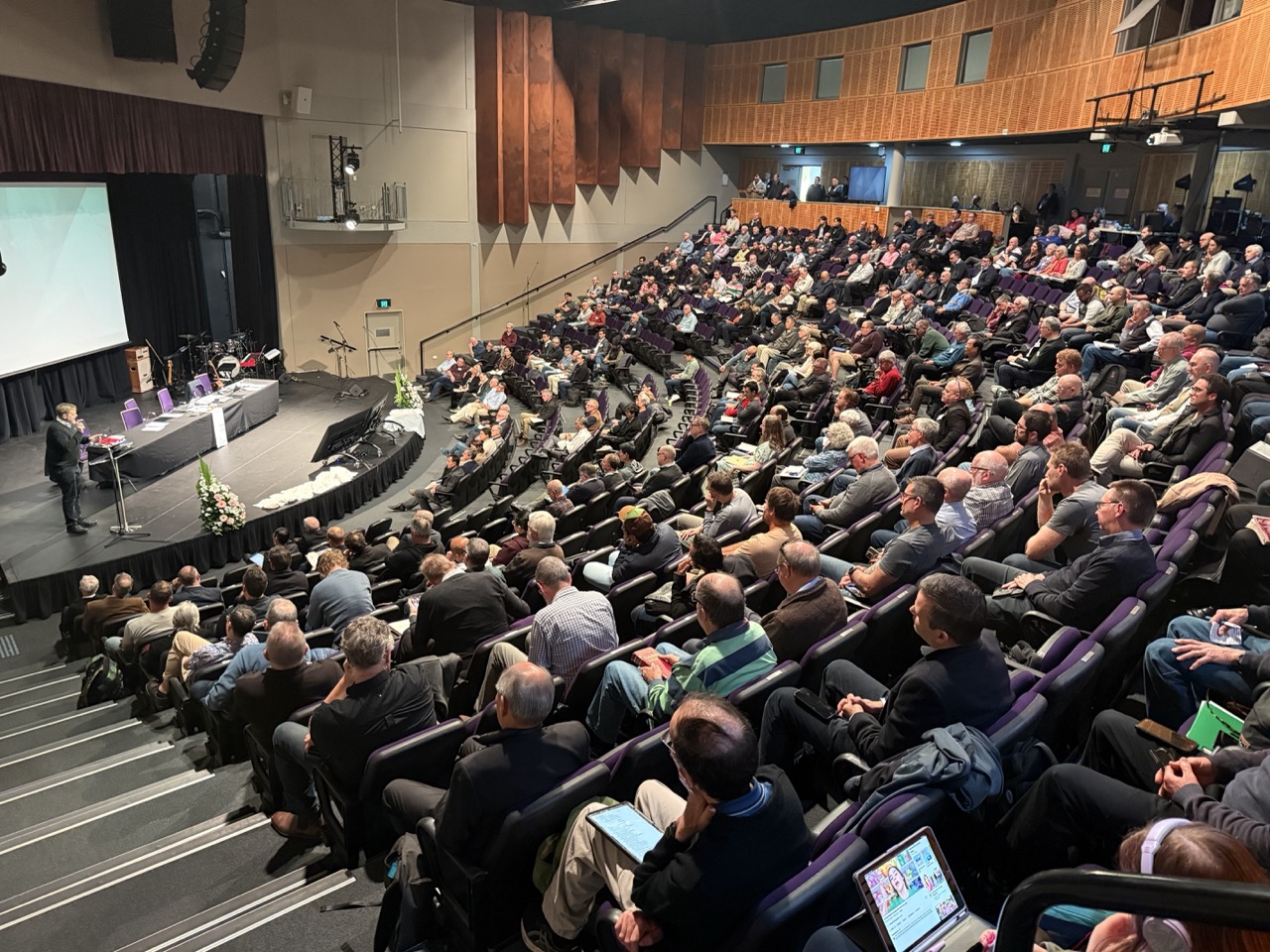
The General Assembly of the New South Wales Presbyterian Church met in the Ladies Presbyterian College in Croydon Sydney last week (14th to 17th July). For those who are unfamiliar with the way that a Presbyterian church works, local churches are governed by kirk sessions and deacons’ courts, or in the case of New South Wales, management committees. Churches within a particular area are bound together in a presbytery. And the presbyteries and local churches meet once a year in a general assembly to discuss major policies and to reflect and view on what is happening throughout the whole denomination.
1) The closure of the Presbyterian Aged Care Committee and its homes.
I feel a real sadness at the closure of these, the sale of the homes raised $43 million. I’m not really sure what was decided here, but it did seem to me as though every committee and organization in the church was looking for something from this $43 million. I think my concern is that the money is given for looking after the elderly, and in my view, much, if not most of it, should be used for that purpose. There is an enormous danger in the Presbyterian Church of using money and legacy from the past to maintain what we have without renewing it or using it for outreach and evangelism. I really hope that someone will find some more creative and sustainable ways to care for the elderly within our churches and communities.
2) The Impact of Work, Health and Safety legislation –
The church has got itself all tied up in knots about the application of the New South Wales Government Work Health and Safety Policy. We had been advised at the last two previous assemblies that we were obliged to consult every one of our members or volunteers if we were undergoing any change which might cause them psychosocial harm. On that basis, the clerk had put forward a series of procedures which we would have to follow if we were enacting any change in our code or practices. I was somewhat disturbed about this, not only because of its crippling bureaucratic effect, but also because I do not believe that the state has the right to dictate to the church how we should make our decisions. In my view, the clerk’s motion was treating the church not as a church, the body of Christ, but as a corporation. So I moved a counter motion. I did not expect to win this. I just wanted to make a plea for a more biblical and Presbyterian church order.
I made the following points in proposing my motion. I include them below together with, in italics, the counter motion itself and the arguments I made for each point. (Actually, I’m not sure I made all these points, because although I had been told I would have 10 minutes to speak, it turns out I only had five, so I had to abbreviate some. But nonetheless, you get the gist.)
Argument and Counter Motion presented to the Assembly.
We fully agree that the members of our churches should be consulted about any significant changes that will occur. But we do not need to establish a new complex, bureaucratic, expensive and unworkable system to fulfill that requirement. In fact, we can say to the government – glad you have caught up – we have always taken into account the health, safety and well-being of our members. Long before ‘safe spaces’ were invented we were a ‘shelter from the storm’ and a ‘refuge for the distressed’.
We need to reaffirm our own system.
The Assembly affirms –
1) That we are a Presbyterian church governed by church courts (kirk sessions, deacons courts or management committees; presbyteries and general assembly) consisting of elders and deacons and those nominated to management committees. (1 Timothy 3:1-13)
We are not governed by loaded and biased opinion polls. I know what the government mean by ‘consultation’ – they generally take on board the opinions of stakeholders who agree with what they want to do.
Despite all the assurances that this was not a vote on women eldership, the clerk proposes that this referendum should be used to cancel the overture even being discussed by the Assembly.
This is not Presbyterian church government – this is the modern politician’s way of governing – mob rule, social media and political campaigns. It will cause untold harm in the Church.
2) That it is the purpose of the officers and church courts to consult with, counsel and pastor the members of the church who are, or may be affected by any decisions made by any of the church courts. (1 Peter 5:1-14)
Ironically the Clerks motion will encourage those pastors and elders who do not fulfill this duty to believe that it is no longer their responsibility and that they can rely on the ‘consultation’ and counselling provided by a committee.
3) That whilst we honour the civil magistrate as being appointed by God, we also affirm that the civil magistrate has no authoritative role in the doctrine, worship, government and discipline of the Church. We reaffirm that “The only King and Head of the Church is the Lord Jesus Christ from whom its powers and prerogatives are derived, so that all its functions are to be exercised in his Name, under the guidance of his Word and Spirit, and in subjection to his authority alone.” (Code – Preface on Government) (Colossians 1:18)
We are in subjection to the authority of Christ alone. When the Assembly decides to handcuff itself to the requirements of the State, whatever they are, we are breaking our code. The only reason for changing to the cumbersome and ineffective system is the false belief that this is what the state requires.
The State once given an inch will take a mile. Take for example the proposed Human Rights Bill being put forward by the Greens MP Jenny Leong – which will significantly impact the rights of parents to educate their children in Christianity. Will the Assembly go along with that.? No, we say to the government you can go this far – but no further. You have no say in the government, doctrine, worship and discipline of the Church.
4) That the state requires us to consult with our members but does not tell us how we should consult.
This is a simple fact. I would argue in any court of the land that our consultation is 1000% better than the flawed, virtue signalling, ineffective ways of this world.
5) That the method of consultation through our current practices and courts is more than sufficient to meet the requirements of the state.
We had been given legal advice at the last general assembly that we would have to consult with anyone potentially affected by any change (basically anyone connected with any of our churches). Some of us asked for an alternative legal opinion but the Assembly in its wisdom decided not to do that. As it turns out our legal advice was wrong. Not every member of the church is considered a volunteer under WHS legislation, and our current procedures are anyway more than adequate to fulfil that role of consultation. The government advice is to “Put WHS on the agenda for council, session, parish, or board meetings, and review hazards, incidents, and proposed changes regularly. That is usually enough to show consultation is happening in a genuine and ongoing way.” In other words, our church courts are adequate for fulfilling the WHS legislation.
6) That the Barrier Act prevents any sudden change without due consultation – in that it requires ‘the whole church’ to know and consider any substantive change, and to ascertain the ‘general opinion’ of the church, before enacting such a change.
This is the key part. We already have written into our constitution an Act which prevents any sudden change, and which mandates us to ascertain the general opinion of the church before we can enact any such change.
What the clerk is saying is that our constitution and code is not adequate enough and we must change it. He is arguing that we should change the code as a ‘temporary’ measure – and yet this change is going to be done without the Barrier Act – it is against our constitution and code.
Therefore, the Assembly
1) Resolves not to add to the bureaucratic burden by adding any additional consultation processes – especially those which undermine the authority and purpose of the church courts.
The clerk’s proposed process is an unnecessary and expensive waste of time. It will make Presbyterianism even more slower and bureaucratic than it already is. It will take at least three years to get anything done. One year propose, one year ‘consult’, one year under Barrier Act. I for one will not be participating in any online surveys, referenda, or opinion polls. And I will strongly discourage others from doing so.
2) Encourages all church courts to ensure that decisions made by those courts are adequately communicated and that those who are most likely to be impacted by them should be consulted through whatever means the church court deems necessary.
Having a survey which is treated as a political campaign is not good communication nor is it pastoral care. Unless the Assembly are going to authorise and pay for Assembly visits to every congregation then we are better to stick with our current method.
By the way one of the big issues in the debate on women elders – and one of the reasons the survey was so flawed is that many of our people, including many elders, do not know what a biblical elder is. To ask people to give an opinion based on ignorance and a flawed understanding is not helpful.
A surprising result
Much to my astonishment, and everyone else’s, my motion defeated the clerks. However, I was somewhat disappointed that in the rest of the Assembly the clerk continued as though his motion had been passed, and brought forward a series of motions based on it. When I challenged this, the moderator ruled in favour of the clerk. I may have some more reflections on this later – when I have thought more about its implications. But it did remind me of the EU – that when they don’t get the result they want in a referendum, they just carry on and eventually have another one – until they get the ‘right’ result.
3) The Return to a male only Eldership
I thought the discussion on this was actually done well. The tone was measured, and the arguments that were made, well put and respectful. What really surprised me was the extent of the vote in favour of male-only eldership. It was more than two to one in favour, despite all that had been said.
I was particularly encouraged by the presentation of Murray Smith, which was clear, concise, scriptural, and respectful. The decision does not remove women elders (about 90) who are already in the church. And it will not become the law of the church unless a majority of Presbyteries approve it this coming year. It also does not exclude women from other roles within the church, nor from having a say in who the elders are.
However, although Craig Tucker’s two models’ paper, which argued for women elders (because apparently, we don’t have biblical elders in the NSW Presbyterian church!) was eventually dropped, there were other hints of trouble still to come. In particular, the enlarging and reshaping of the Assembly into a body which would include a significant number of non-ordained elder and ministers – with a right to speak and participate but not vote. The whole question of what a deaconess is, and indeed what deacons are, also appears to be up for grabs. There is a confusion here that we will need to sort out at future Assemblies.
4) The methodology of Evangelism.
This for me was the most important issue facing the assembly. I was a little concerned that the whole subject of evangelism would go by virtually unmentioned. So, I proposed an alternative to the ministry and mission report. What the report said included the items below.
6. Set a target for average weekly total attendance of at least 22,000 people, representing four consecutive years of 5% attendance growth for every church, to be achieved by the 2030 Assembly.
7. Urge every session, in humble dependence on God, to bring the matter of the 2030 target to their congregations for prayer on a regular basis.
Now, what I didn’t like about this is this setting of a percentage target. This 5% target is all the rage. It is the doctrine of Reach Australia, Sydney Anglicans, and the Gospel Coalition. Within these organizations, I am sure there are people who do not agree with using percentage figures as a means to motivate people to evangelism. However, it is the predominant methodology within evangelicalism in Australia, and I strongly disagree with it.
So, I asked that the assembly replace the committee’s original six and seven with the ones below.
6. Encourage the committee to look, together with other interested stake holders, at the possibility of setting up a conference to look at a strategy for evangelism throughout the NSW Presbyterian Church.
7. Urge every session, in humble dependence upon God, to bring the matter of local evangelism to their congregations for prayer on a regular basis.
My argument was essentially that 5% was far too little a target. 5% in terms of Scots Kirk would be four new people per year. I am disappointed if I do not see four new people per month!
But my real issue is with the whole setting of targets anyway. Why do we have them? Because we see them as doable and as manageable and as something that we can cope with. But to me, that places far too much of the emphasis upon us and not upon the Holy Spirit and what God does through his word.
I know that there are people who argue that if you aim at nothing, you will achieve nothing. Which I completely agree with. But we don’t aim at a percentage target. Surely our aim is to communicate the gospel to all the people in our area so that many of them will come to believe, and that God will be glorified through the salvation of sinners? God has many people yet in this city. We do not go to him and tell him what percentage we are looking for.
Anyway, that’s a subject I’ve written on before and doubtless will write on again. But I am delighted to report that the assembly decided to go with me and not with the committee on this. To me, even though we are out of step now with some of our brothers and sisters who are closest to us, yet what we adopted was a more biblical and Presbyterian theology and practice of evangelism, and for that, I am extremely thankful. I wish them well and pray that all of us would see real Gospel growth.
Conclusion: These are some of my reflections on what happened. I may have some more private thoughts later on, but I need a chance to reflect and pray. All in all, I think it was a significant assembly where there was a sea change, and perhaps a return to a more biblical form of Presbyterianism. Time will tell. May the Lord have mercy.
David Robertson
On the WHS legislation: A very well articulated lesson for legacy institutions and established businesses in resisting the impulse to bend to fleeting bureaucratic fads. Well done David.
Thank you for your detailed report on the Assembly. I am in agreement with you about elders and I agree about the evangelism question because God makes new hearts to believe in Christ. We should therefore work as if it all depends on us, or work with enthusiasm from God, but pray as if it all depends on God, which it does.
It feels rather awkward, commenting on the business of another Presbytery. However, I am sure that the success of your rewording, of section six of the evangelism motion, would not have been a surprise to a veteran presbytery battler such as yourself. After all, it contains all the required ingredients:- 1. Kick the can further down the road, 2. Set up a consultation with unspecified others, 3. Form another committee or, even better, a conference, 4. Qualify the whole thing as a possibility. It was never going to fail.
I would suggest that a far greater concern is the striking down of your challenge, to the pursuance of the motions subsequent to the success of your motion in the WHS debate. Experience suggests that the fear of legal liability is very real. That fear is then enough to silence most dissent. Marginalisation takes care of the few, like yourself, who remain. This in turn paves the way for governance by management structures based on legal advice. The decline that follows is, perhaps, inevitable.
It is easy to diagnose the problem, but far more difficult to resolve it. Sadly, it may have to include some effective form of liability insurance, for those in positions of responsibility, at both presbytery and congregational levels. Not to forget protection of pension funds.
Yes – it was a complete surprise. I was going against the committees report and against the current ethos in Australian evangelicalism. And no it was not a kick down the road motion! I agree with your ‘greater threat’ comments….
I’m finding this fascinating both mentally and spiritually. There is the pronouns element to wrestle with as well as the fact that in your photo – there are a distinct paucity of female representatives.
I have no problem with pronouns…men are he/him. Women she/her. And men can’t become women or vice versa.
As regards your second point we run the church as Christ tells us to….and don’t care about whatever passing fashion the world is adopting. Our eldership does not operate on a representative basis.
I suggest you have a word with Jesus – if you were to take a photo of the 12 apostles you would find a distinct paucity of female representatives!