
This article was first published on my Substack here. (and also on AP)
Counsel Culture and the Church
Western culture can be summed up with three words – cancel, consumer and counsel. In a week where a well-known TV journalist was cancelled because he interviewed someone the establishment don’t like; we have seen evidence of the first. The impacts of the consumer cultu re are all around us. But what do we mean by a ‘counsel’ culture?
In ye old days, when I was a young man, if something terrible happened in our community it was the police, the magistrate, perhaps the teacher and the clergy who helped us with our shock and grief. Over the years I have noticed a profound change occurring. More and more professional counsellors were called in, and the ‘amateurs’ (teachers, social workers and ministers) were more and more sidelined. Counselling as a profession was only really established in the UK in the 1960’s. By 1970 there were a few hundred. At the turn of the century, it was around 20,000. But today it is estimated that there between 80-100,000. In Australia the number is 40,000 – a doubling in the past 15 years. It seems that counselling is in vogue. We are a counsel culture.
One of the reasons for the increase is that the number of issues we can receive counselling for keeps increasing. We have moved from counselling for the trauma of death, horrific accidents and terrible abuse, to counselling for hurt feelings, ‘harmful’ words and even political results. When Trump was elected , some school districts in the US offered professional counselling to their students (it is unlikely they would have done so if Clinton had been elected). I suspect if Pauline Hanson spoke at Sydney University counselling could be offered. Perhaps counselling should have been offered to the long-suffering Scottish football supporters?

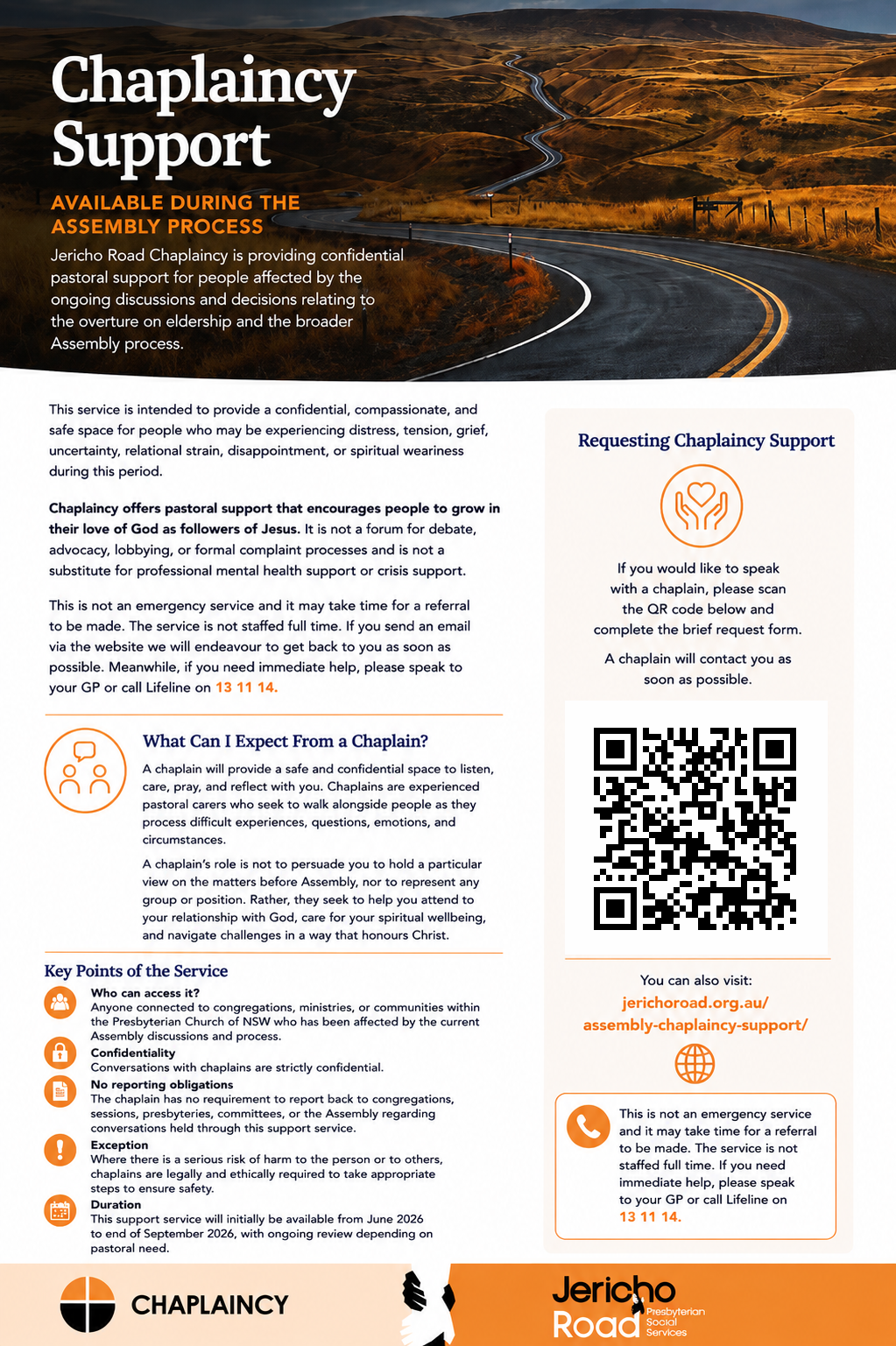
Where the culture goes you can be pretty sure that the Church will follow. Which is why I was not surprised at an e-mail I received in preparation for the upcoming NSW General Assembly. To quote the letter “The Assembly is providing confidential pastoral support through Jericho Road Chaplains for people affected by the ongoing discussions and decisions relating to the overture on eldership and the broader Assembly process.”
What precisely is being offered? See the attached leaflet that is publicly available. This is not only for the members of the Assembly but also congregations, communities and individuals within the Presbyterian Church who “have been affected by the current Assembly discussions and process”.
Surely this is a good thing? After all, shouldn’t we all want to provide “a confidential, compassionate, and safe space for people who may be experiencing distress, tension, grief, uncertainty, relational strain, disappointment or spiritual weariness during this period”. It sounds great and just the kind of thing Jesus would do…. I am sure that those who have decided this should be provided have the best of motives and a genuine pastoral care. I’m also sure that at the back of their minds is the secondary factor of Health and Safety legislation from the government. What are we offering for those who suffer from psychosocial distress?
I can recall many Assemblies where the decisions, conduct and manner of discussion caused me distress, tension, grief, uncertainty, relational strain, disappointment and overwhelming spiritual weariness. I have had sleepless nights, headaches and have several times been on the point of giving up and resigning. Ironically one of those times was when I watched the Assembly descend into chaos on precisely this issue of psychosocial distress. But what did I do? What did I need? Not counselling in secret. I needed to pray and seek the Lord. I needed to remember not to be anxious about anything, but in every situation, by prayer and petition, with thanksgiving, present my requests to God. (Philippians 4:6-7). I needed to know that ‘underneath are the everlasting arms (Deuteronomy 33:27). I needed to speak to my brothers and sisters in Christ.
Some people would argue that whilst I could do that perhaps others were not in that position and needed some extra support. Perhaps. But have we really come to this? Consider what the message of this leaflet is.
1) That the General Assembly is so dangerous that people need to be offered specialist counselling to help them cope with it. The leaflet even suggests that if the counselling is not immediately available that such could be the distress caused that the applicant should go to their GP or phone Lifeline. Seriously?! Do we really believe that even discussing women elders could lead people to illness or suicide?!
2) The message has the effect of curtailing discussion. Watch what you say. You can’t discuss that. You will hurt someone’s feeling. This kind of message puts a dampener on the full, open and frank discussion that should be what happens when we meet in General Assembly. It also allows people to play the ‘hurt’ card. A very 21st Century way of winning, or at least shutting down, an argument.
3) The message is in my view somewhat unintentionally misogynistic. I can’t help but feel that there is something of the ‘weaker female’ partner here. It’s fine for me to be shouted at an Assembly – I should just ‘man’ up and take it. But if it was a woman? Are we hinting that women are more emotional and therefore will be less likely to cope with this discussion?
4) The message undermines the value of real counselling. There is a real place for professional counsellors. But that place should be limited to areas where it is really needed and where the normal church, family and personal resources are not sufficient.
5) It undermines the Presbyterian church discipline and church order. Surely if we were proper churches the place for this kind of discussion and pastoral support is from within the local church body? When we start professionalising pastoral care, we are beginning a journey down a very slippery slope.
6) It appears to be a form of virtue signalling. Whilst I am sure that the intent was good – I am also sure that the WHS people were thinking that this helps us show how much we ‘care’ and how we are providing suitable psychosocial care. Again, that is a dangerous road to go down. Should we offer counselling for an organist whose services are no longer required because the church has changed their style of worship? What about the bible study leader whose group is closed down because the elders are concerned about what is being taught in it?
7) It magnifies one issue at the expense of others. Why is this being offered for this particular discussion but not for others? I have witnessed the distress of a minister being fired, scripture being sidelined, and divisions within the church. But have never been offered counselling. I care far more about how we evangelise, than who we have for elders, (although the two are not unrelated), but no one would (or should) think of offering counselling to those who are upset because they don’t get what they want.
8) It is unbiblical. Can you imagine the Apostles and elders at the first General Assembly (Acts 15) offering confidential counselling for any who were upset by the decisions of the Council of Jerusalem? (Acts15). Or Paul offering the Ephesian elders counselling after he had warned that some of them would become wolves? (Acts 20). Why did his upsetting first letter to the Corinthians not come with at least a trigger warning?
None of this is to deny that there may be things said that are hurtful – and that should be dealt with biblically (see Matthew 18:15-20). Nor is it to deny that there could be genuine distress, confusion or hurt and again that must be dealt with biblically.
So how should we deal with this? Can I offer another three Cs.
Let’s begin with Calvinism. Let’s bring our theology into play. Our doctrine, worship, ecclesiology. This is not politics. It’s not sociology. It’s not psychology. Our doctrine of the Church tells us that we are a body where all are equally valued and valuable. (1 Corinthians 12). The hierarchical corporate model of the Church where ministers and elders are at the top is not one that we should hold. We also know that all things are in God’s hand.
Then we need compassion. Not the professional compassion of a detached, paid for counsellor, but the compassion of a brother and sister – or the compassion of an under shepherd – a pastor or elder who truly loves us as one of the sheep. There are women in my congregation who probably disagree with me on this issue – as well as those who agree. Of course I will care for them as much as for anyone.
Finally, we do need a counsellor – the Spirit of truth. The advocate who is to help us and be with us forever. (John 14:15-17); the one who brings us Christ (John 15:26), the one who is sent by Christ precisely for this purpose (John 16:7). We don’t follow the world. We don’t let the world convict us of ‘sin, righteousness and the judgement to come’. It’s the other way round. Perhaps the church needs less of the mind of this world, and more of the mind of Christ? Lets have a real cultural change.
Actually we could add a fourth – Christ – but I tend to see Christ in all the three above. Our theology is about Him and pointing to Him (and His Father and Spirit); Any compassion that we feel and exhibit must be the compassion of Christ. And the Spirit as we have seen is the one who brings us Christ.
Philippians 4:6-7:
Do not be anxious about anything, but in every situation, by prayer and petition, with thanksgiving, present your requests to God. 7 And the peace of God, which transcends all understanding, will guard your hearts and your minds in Christ Jesus.
Here is the leaflet we are asked to offer and that I am commenting on
I agree with much of what you say here. We need to be careful not to curtail discussion; people should be able to debate openly and freely, and indeed sometimes emotions will rise there – I’d say rightly so – why would we debate if we weren’t passionate?
However, it’s also important to recognise that some people are operating at 99% of what they can manage mentally, and any extra thing has the capacity to break them, and drive them into a weird state that they cant even understand themselves. This happened to me over the past year, and I sought council from a professionally trained councilor who is also a Christian. That helped immensely and profoundly. I would have gladly sought this from the church leaders from my fellowship, but they either cut off communication with me, or they were part of the posse that drove us out. I did seek help from elders in another local church, and we started attending another fellowship, and that was very helpful.
Sometimes the structures that should support us fail, or even do the opposite. I think we as the church need to do a lot better job at this – then we may not need so much ‘professional’ help. And by the way, I see myself as someone who has failed others in the past in this respect too – this has been a season of learning for me.
Thanks for your thoughtful article.
Thanks Simon – that is very helpful. I would suggest that someone who is overloaded to the extent you suggest – that they should not be attending the Assembly….and if they are in ministry they should take a break and perhaps get some help. I am so sorry that the elders in your own fellowship were not willing to help – that is what they are there for…..!
It’s a bit simplistic I think describing journalist Karl Stefanovic as being ‘cancelled’ for interviewing ‘someone’, Tommy Robinson is his stage name, the ‘establishment didn’t like’. ABC Media Watch’s Lynton Besser explained well why cosying up to a criminal without asking serious questions about his behaviour and views is not good journalism. Having a jokey chat with ‘someone’ who’s been filmed and served prison time for bashing people from migrant backgrounds and pretending that’s OK raises moral questions about interviewee choices. Karl got dumped for good reason, not cancelled. He wasn’t doing a good job.
I responded with this on your Substack. You’re spot on about people at the level of emotional instability that they can’t handle a difficult denominational discussion shouldn’t be at a denominational assembly at all. I’ve seen a lot of misuse of counseling but this pretty much is the most egregious example of misuse I’ve seen yet.
_____
Wow. My wife (now retired) is a clinical psychologist who worked for many years in private practice outside Fort Leonard Wood in the Missouri Ozarks, home of the US Army’s Engineer School, Military Police School and Chemical School.
She didn’t get two masters degrees and a doctoral degree to deal with people whose feelings might be hurt with stuff that got said at a denominational assembly. It doesn’t take much to connect the dots and figure out what the US Army has been doing since 9/11 and realize her clients were dealing with a lot more serious stuff than “unkind words.”
I have spent decades arguing in the conservative Reformed world that, while limited, there is a legitimate place for trained professional counseling beyond what most (not all, but most) ordained ministers and elders can do. Conversely, there are things that a chaplain or civilian pastor who is a combat veteran can do that my wife cannot and SHOULD NOT do. Both my wife and I had fathers who served in the military, but being a family member is NOT the same as combat. Some things are best said by a person with shared experiences.
However, this sort of nonsense is the sort of thing that causes conservative Reformed people to attack the counseling profession. The profession has a place. The place is limited. This isn’t even close to being the place for it. Candidly speaking, any elder or pastor who needs counseling after a denominational meeting probably needs to resign from office based on emotional instability and inability to handle pastoral duties, and the only counseling to be sought is from the session/consistory/eldership or presbytery/classis/association in determining the right way to resign without doing more damage.
Thanks….a helpful perspective…