

Letter from Australia 124 – A Disappointing Conference on Evangelism.
Dear Brothers and Sisters,
This week I was at a conference on evangelism. I was really looking forward to it, but I ended up being frustrated and really disappointed. Let me explain why
I came to Australia to get involved in evangelism. Evangelism being the communication of the good news of Christ to people who desperately need Him. I wanted to learn both how to do it better, and also to share in actually doing it.
Despite the change in employment from City Bible Forum to Evangelism and New Churches (of Sydney Anglicans) and now to Scots Kirk Presbyterian – my aim and heart has always remained the same. So, I was delighted to read that the excellent Nexus conference in Sydney was going to focus on evangelism. I signed up immediately!
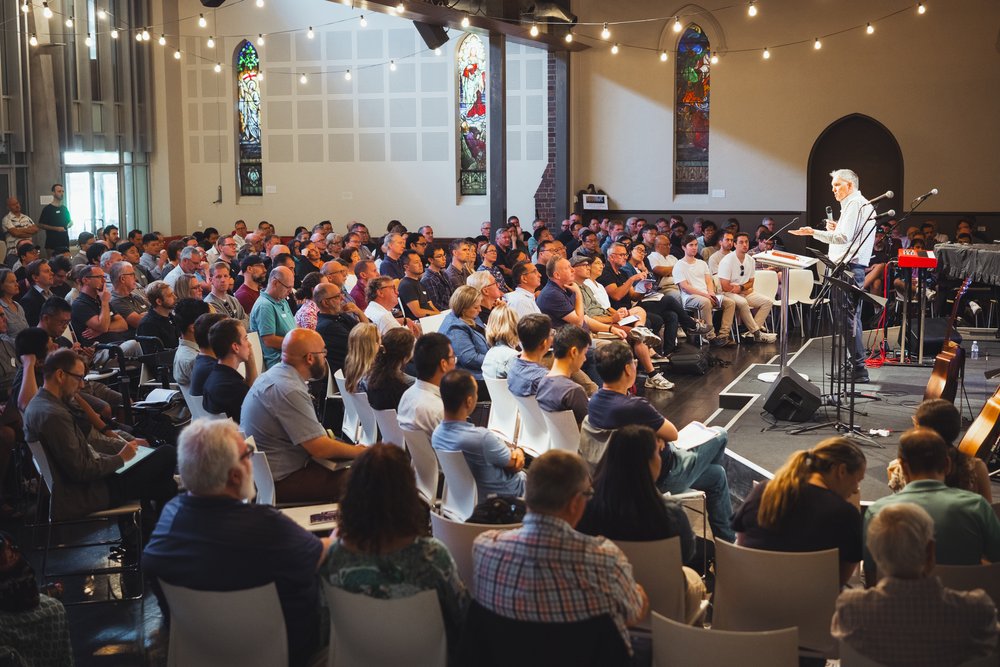
On Sunday evening we drove down to Sydney and Monday I headed off with a degree of anticipation to the Village Church, Annandale.
To begin with we were given some of the bare statistics about the decline in Sydney Anglican churches. The number of large churches has dropped from 21 to 10. 63% of Sydney Anglican churches have decreased, and even those what are not declining are growing primarily because of transfer growth. These figures are unquestionably accurate as Sydney Anglicans are very good at figures and have a mine of data information.
 One particularly disturbing statistic was that in 2001 it was reported that 12.4% of attendees in Sydney Anglican churches had become Christian in the previous five years. In 2021 that percentage had fallen to 5.4%. Whilst it was accepted that there are national, community and cultural factors at play, there was also a recognition that there seemed to be a particular problem with Sydney Anglicans. What could be done about it?
This is an important issue – not just for Sydney Anglicans – but for the wider church in Australia – including the Presbyterians – because Sydney Anglicans have been a dominant and influential force in the Australian church for many years. Their methodology, ecclesiology and theology dominate the evangelical scene in Australia – and is a big influence on many other parts of the world – including the UK, Africa and the USA.
The speakers at the Nexus conference showed why. Chris Braga and Phil Colgan are two excellent pastors who spoke well. Dave Jensen is probably the best-known Australian evangelist working in Australia, and is certainly one of the best speakers. He has a sharp mind and a Godly passion. Dominic Steele, pastor of the Village Church, in whose church Nexus is held has a great podcast – The Pastor’s Heart – which really does give insight into the world of Sydney Anglicanism.
So, given all of that – why was I so disappointed and frustrated that I actually left early? I had paid for the whole day and as a Scotsman, I believe in getting value for money – so why miss the lunch and the afternoon session? Because I just found it too painful – and by the time we got the end of the Q and A session I realised that this was not my world, and I had nothing to say into it. Given that I had worked in this world for four years this was a profoundly disappointing experience.
I have wrestled with this over the past 24 hours – including a restless night. Trying to work out why – and what was wrong with me! I write this not in order to attack people – nor even to just engage in self-reflection – but I hope to help myself and others think through some of the issues raised.
There was much that Braga, Colgan and Jensen said that was helpful and instructive. But overall, I felt that the message was like that of a defeated political party which says, “The people are not getting our message, we just need to repackage it and carry on doing the same thing”. Let me just list some of the points I struggled with. (By the way I confess I may be wrong – this was part of my frustration and sorrow – what if I am wrong? What if these brothers have really got it right and their model is the one we should all be following?). But let’s look at some of the issues where I felt there should have been at least some discussion.
- Ministry is tough. Yes, it is. But we need to ask why? And we need to ask why so many ministers crash and burn – and why there appears to be a relative reluctance for pastors to become senior rectors in the Anglican system.
- Never let evangelists be in charge of the church – Why? The implication seemed to be that evangelists would be so concerned to get people in by any means that they would let theology, or ecclesiology slip. Yet it was Paul who stated that he became all things to all people that he might win some (1 Corinthians 9:20) ….and it was to Timothy, the pastor, that Paul said he should do the work of an evangelist in order to fulfill his ministry ((1 Timothy 4:5). I realise that in the context of the ecclesiology of Sydney Anglicanism this comment makes sense – but I just think that it is the ecclesiology that is wrong and does not reflect the biblical view that evangelism, church and theology go together. This was an especially poignant point to me because I once had a senior Christian argue against me being called to a particular charge because I was an evangelist and the last thing that the church needs is a minister who is an evangelist. I have also heard pastors say that evangelism wasn’t their thing and therefore they didn’t want to do it. How can you be a pastor with that attitude?
- In order to do effective evangelism, we need proclaimers rather than apologists? Churches with most conversions see minimal apologetic detours. It’s almost become a cardinal doctrine amongst Sydney Anglicans that apologetics is somehow a hinderance to evangelism. The irony is that one of the people most responsible for this doctrine, Philip Jenson, is himself one of the best apologists in the business! Again I think the problem here is a misunderstanding of what apologetics is. Almost all of the early church fathers would have regarded themselves as apologists for the gospel. And I am certain that Peter, Paul and the other apostles did so as well. They debated from house to house, in the synagogues, the temples and the marketplaces. We are always to be prepared to give an answer to everyone who asks us for the reason for the hope that we have (1 Peter 3:15). I don’t think that Peter meant we had to learn a formula from a booklet that we could repeat ad nauseum to all and sundry! I don’t understand how you can be a proclaimer without being an apologist, or how you can claim to be an apologist without proclaiming!
- I wanted to point out what Tim Keller said when asked what he would change in his 30-year-old self. His reply was that he would not teach his congregation an evangelism programme – instead he would ask what three questions they were most scared of being asked. I wanted to point it out – but for some in Sydney Anglican circles citing Tim Keller is enough to make you questionable – to say the least. And to be questionable in this context is the equivalent of being thrust into outer darkness!
- Focus on the People Most Likely to be Converted –
I understood what was being said here – and to some extent can appreciate it. But the reality is that conversion is a sovereign work of the Holy Spirit, and he doesn’t tell us who is going to be converted – nor how. I don’t think we should second guess Him. It may not be the way that advertisers do it – but I honestly believe that the church should never target particular groups – especially based on the perception that they are the most likely ones to be converted. We don’t know. I suspect that in this context the speaker was talking about the methodology used – that as he claimed, most adult converts are converted in evangelistic courses – but even given that questionable premise – I am not convinced that it is right to us to restrict the Holy Spirit to the way that our focus groups say He will work!
- The Mission Pathway is Contact, Connect, Conversion and Church Life.
I am not convinced that there is a ‘mission pathway’ but I agree there are basic principles. In terms of what we can do I would agree that we can contact, and connect. But we cannot convert – nor should we seek to do so. I would replace ‘conversion’ with ‘communication’. Our aim is simply to present Christ, in the power of the Spirit, knowing that the Lord’s Word will not return to him empty.
- The most likely places for adults to be converted is on courses – and also personal one to one evangelism.
This is often stated – but I would love to see the evidence for it. I once spoke to an Anglican church leader who told me that he thought the purpose of his Sunday services, as regards non-Christians, was to get them into one of his courses. That seems to me the complete reverse of what should be.
This also seems such a narrow and mechanistic methodology. What about the foolishness of preaching? The Holy Spirit? Hospitality? Prayer? The Internet? Books? Mercy ministries? The arts….?
- What do we want people to experience? That is a great question. My answer would be that I want them to experience Christ. And I would argue that one of the best, if not the best, way to get that is through something that Sydney Anglicans deny exists – public worship. I heard recently of a pastor telling his worship leaders that they should not begin the service by saying let us worship God – because that is not what we are doing – except insofar as everything we do is worship. The loss of the concept of public worship is as big a disaster for the church as is the loss of the Lord’s Day. And it is removing one of the key components of evangelism – the opportunity to ‘taste and see that God is good’, and to come into a service of worship where you so experience the presence of God that you ‘fall down and worship God, exclaiming, ‘God is really among you’” (1 Corinthians 14:25). In rejecting sacramentalism and an over realised religious liturgy, Sydney Anglicans have thrown out the baby with the bathwater by denying public worship.
- If we change our practice, we will see people become Christians.
If only it were that simple! Doubtless we need reformation. But I suspect it needs to be a lot more radical than a change of programme – and without renewal and revival it will only be rearranging deck chairs on the Titanic.
- Evangelism is easy if you have the courage.
In one sense evangelism is easy – if by evangelism you simply mean telling people the good news about Jesus. And it does take courage. But it also takes wisdom, understanding, love, prayer etc. And evangelism is the most difficult thing in the world. This is bringing the spiritually dead to life – and that is even more miraculous than the raising of Lazarus! (John 14:12). In order to present everyone fully mature in Christ we have to ‘strenuously contend with all the energy Christ so powerfully works in us’ (Colossians 1:29). It’s a battle. It’s spiritual warfare. It involves suffering and sacrifice. It means dealing with ‘hollow and deceptive philosophies’ (Colossians 2:8). If people believe that evangelism is easy if only you have the courage, then they will end up being disappointed, frustrated and disengaged.
- There are no blockages out there – at least none that have not existed before.
It is of course true, and a truism, that there is nothing new under the sun (Ecclesiastes 1:9). But it is also true that there are differences in culture and society over time – some of which result in increased blockages to the Gospel. We are to be like the men of Issachar who understand the times (1 Chronicles 12:32). In terms of Australia there are real blockages to the Gospel (apart from the fact that people are dead in sins and trespasses!). Materialism, ignorance, pluralism, hypocrisy in the church etc have all existed before – but they may do so to different degrees. If I wish to reach the Chinese community then one of the blockages may be that of language. Surely learning Mandarin might be a good way to communicate the Gospel? And what about the ‘defeater beliefs’ of our culture? Are they not often different than those of 50 years ago?
- You don’t need to start further back…just start with the Gospel
This sounds as though it should be right. But it’s not biblical – at least not if you read through how the early church evangelised in the book of Acts. They often did start further back – take for example Paul in Acts 17. He started way back with the idolatry and confusion of the Greek gods in Athens!
- We don’t need to be experts in their worldview – we need to be experts in the Gospel –
I am not sure what being an ‘expert in the Gospel’ means. I realise it is a rhetorical flourish which is basically saying that to communicate the Gospel all we need is the Gospel. But that is demonstrably not true. We need to know the best way to communicate. And therefore we should seek to understand and know the people we are trying to communicate with. For example, I once found myself in a lot of trouble because I asked Muslims in a questionnaire ‘do you think Jesus is the Son of God’? As someone with a Gospel understanding of the Trinity, I thought that was a straightforward question. But instead, they heard something completely different – so grotesque and blasphemous I won’t write it down! I was saying one Gospel truth – they were hearing something else. We don’t need to be experts – but we do need to have some knowledge. Just because God can speak through the mouth of a donkey does not mean that we should all behave like donkeys!
- We are not in a post Christian age because we were never in a Christian age.
This again is one of those truisms that works because it is at least partially true. Australia was never a purely Christian country. But it is ahistorical nonsense to imply that there was no Christian age. When the Macedonian cry came (Acts 16) to Paul and as a result the Gospel went West into Europe it was one of the key events in world history. As a result Europe eventually became Christian Europe. You have to have a particular form of pietism to deny that historical fact. Furthermore, when the first fleet came from the UK to Australia it did as coming from a nation which was largely founded upon Christianity – and it brought those Christian values into the founding of the new nation of Australia. Yes – there was a Christian age – much of the fruit of which still remains. But as the root is being, or has been destroyed – that fruit too will eventually rot. We are either in, or moving towards a post-Christian age. To fail to recognise that is a major weakness in some of the Church – and will hinder our evangelism.
- The Christian worldview doesn’t make sense unless you believe that Jesus died for your sins –
The speaker then went on to cite Acts 17 as an example where Paul just gave an illustration at the beginning and then a straight gospel presentation. The only problem with that somewhat limited analyses is that Acts 17 doesn’t mention Jesus dying for our sins. Does that mean Paul’s Gospel presentation was inadequate?
Conclusion
Why did I not make these criticisms within the conference? Because despite the self-description of this being a place where straight talking could be done – it just isn’t. I suspect we all live in different bubbles – but when your bubble is a comfortable one, and a relatively big one, then you tend not to see beyond it – other than at a very superficial level. After all you don’t need anyone else. I did try to raise these issues when I worked for Sydney Anglicans – but as one senior figure told me – every time you raised your head we squashed you like a gnat (or wee flea)!
Much of Sydney is a bubble in Australia. And much of Sydney Anglicanism is a bubble within that bubble. Anyone who threatens to prick the bubble will not last long. I did not want to stand up in a conference where I didn’t belong and say things which no one wanted to hear. Being a Jeremiah only really works if you are Jeremiah – and God has called you to that.
My view is that this conference ended up being just a call to repackage Sydney Anglicanism so that it was a bit more palatable to the people who are already within its orbit. It is the same stuff over and over again. But what if it is not just the packaging that is wrong?
The conference had the subtitle “God is not finished with Sydney”. I suspect that is true – but that does not mean He is not finished with Sydney Anglicans. Sometimes the candlestick is removed (as has happened to the Church of Scotland). And I would not be certain that God is not finished with Sydney. Or at least it may be that first He will judge the city for its pride, wealth and hubris; before He moves in revival and renewal.
Despite all of the above I do hope that the rest of the day went well. I also hope and pray that the Lord is not finished with Sydney Anglicans and that there will be renewal and revival amongst the brothers and sisters there. I give thanks for the ministry and work of Chris Braga, Dominic Steele, Phil Colgan and Dave Jensen. We need many more like them….and they need to escape the straitjacket that Sydney Anglicanism imposes upon them!
Be interested to know your thoughts….and to be corrected…iron sharpens iron….
Yours in Christ
David
PS. I have been asked to clarify something – was I making any kind of comparison with NSW Presbyterians? Not at all. We are in as desperate a state – if not worse. I suspect we too are at a crossroads – we will see in the next couple of years which direction we will go….I also don’t think that the answer is either Presbyterian or Anglican, or indeed any other denomination…somehow we need to all swallow our pride and genuinely work together…
Closing the Gap – A Better Way to Connect Bible and Practice – Regulative or Normative?
My single experience of DJ was his preaching, on invitation, to an 8am, prayer book service, SydAng church, that is good enough for a visiting English Monarch, and that is very accustomed to its preachers in jacket and tie. DJ’s exposed arms and tattoos were poor optics (an opinion that the 5pm congregants would not have shared later the same day).
There was nothing wrong with DJ’s message that day yet I’m left pondering whether he has the sensitivity of a gnat.
And maybe that is the core of the SydAng evangelism problem?
Evangelists often seem insensitive to the saved, and the unsaved churchgoer.
But they are the aroma of salvation to those God is saving.
Jacket and tie? Whatever happened to proper Anglican choir dress—cassock, surplice, scarf and hood?
Thanks David.
Living in Perth my interaction with Sydney Anglicans is quite limited.
The situation in Perth is not [generally] so rosy as in Sydney…..
I empathise with your concerns. We may too easily become blinkered. [Presbyterians too!]
Surely there should be a forum where without prejudices or unshakeable loyalty to a denomination ‘Iron may sharpen iron’ ?
If not, that might be a good thing to contemplate?!
In my view the roots of our struggles are spiritual & moral, rather than methodical and managerial.
Indeed, has English speaking Anglicanism become obsessed with evangelism methods and models? Go into an average city coffee machine shop, and they will try to sell you various expensive devices or pod systems. Step into a top class coffee specialist, and you may be surprised to see just three items: 1) High grade beans or ground beans 2) An old fashioned plastic cone filter 3) Coffee filter papers. Our Lord instituted sacraments with water, bread and wine, or oil as well, if you include healing prayer with anointing. Yet modern Anglicanism rarely sticks to the basic elements, or the three C’s-creation, conscience, Christ. My instinct is to see apologetics use (and prayer) as being vital in evangelism. Predestination means that God’s will is for none to perish, and this should encourage us to communicate the Apostle’s Creed faith with absolute clarity and zeal. Also, in moral terms, why Anglicanism’s fixation on SSA, yet an aversion to proclaim the pro-life Biblical position from many pulpits. I have never in 25 years heard the pro-life topic done justice in Anglican settings.
To your point about the coffee speciailst, and to offer some current context, I’ve experienced the oddity of SydAng messaging on the Australian same sex plebiscite – which was messaging of “I won’t tell you how to vote” & the subsequent messaging on the Voice referendum (which deepened indigenous rights in the Australian Constitution) – which was messaging of “I will tell you how to vote”.
Now, that’s a Diocese that’s clearly astray of its speciality – that it can’t message correctly on a core Biblical human sexuality issue whereas it messages strongly on a referendum matter that it hardly should have been leaning into.
Your second point about Evangelists should not pastor a church is something that I heard from a very young pastor about fifteen years ago and has led to my blog, in a fashion. He said that pastors stay at a church to do pastoral care. They are loved by their congregation (ideally). But evangelists must move on. They ask the hard questions that make people uncomfortable at times. A steady diet of that would be uncomfortable within a congregation. At the time, I argued against it, being old enough to remember, I can remember the fire and brimstone pastors of my youth (rarely in a Presbyterian church, but on the radio or visiting with a friend). But since his little private talk with me (when I was in charge of evangelism at the church), I have seen how people within the church are split as to who likes me and who doesn’t, and I have noticed how pastoral care and evangelism is a tumultuous mixture.
I resonate with your overall concerns, David, not because I was at the conference ( I wasn’t) but because I have had concerns about some of your points for a long time. A couple in particular are ‘Ministry is tough. Yes, it is. But we need to ask why? And we need to ask why so many ministers crash and burn – and why there appears to be a relative reluctance for pastors to become senior rectors in the Anglican system’. I think this begs a much wider question – what actually is ministry? How relevant or even Biblical is the prevailing clergy model of most protestant churches? This is likely to be controversial but I believe it is a pragmatic model that, amongst other things, sets up ministers for failure or burnout. ‘Focus on the People Most Likely to be Converted’. Like you, I can understand the reasoning, but this notion, right from when I first heard it decades ago, I have found wanting, even appalling, for the reasons you have stated.
Seriously David, you continue to surprise me in your reactions to the circumstances in which you place yourself. You attend a convocation of evangelicals, part of what you describe as the current “scene”., and leave at half time. You cite the pain it caused you and the fact that you feel it is not your world. It isn’t. Your world is God’s world. There are times when it resembles the outer darkness, with only Tim Keller for company. But look again, that is His “scene”.
I suspect the evangelism that so discouraged you is no different from that which once existed in the Church of Scotland, and will just as easily be bought off.
Go back and look at the question you pose. Do these brothers have the correct model. Of course they don’t. But you more than most of us know who does.
I have listened to your sermons over the years and often heard things with which I could take issue. I came to the realisation that I was being challenged. I am sure that nobody leaves your church at half time.
I think I might have reacted the same way as David had i attended this conference.
I grew up Sydney Anglican, moved to Victoria mid 1970s (so I’m old).
I attend a Presbyterian Church in a deprived are of Melbourne. We gather to worship God first and foremost, and we do it with the church of all nations past and present including the saints in glory. We have a call to worship, prayer of adoration, confession of sin, assurance of pardon, and yes, we love one another intensely and fellowship together over morning tea/coffee.
Nothing too spectacular. Ten years ago, the then minister was removed for moral failure with twenty or so dispirited people remaining. Fast forward to today, a church of all nations (15 plus national origins) 70-80 persons worshipping God, loving one another, an amazingly attractive congregation to join. We have a wide spread of ages and include at least 20 plus children. And yes we do have some outreach activities, including a weekly Foodbank, for what turn out to mainly be Muslims, who willingly attend our Carols service on the church lawn.
Several years ago, my wife and I travelled north into NSW and Qld, three Presbyterian, one Baptist church attended. Man focussed, not God focussed. Only one had confession of sin, though without assurance of pardon. So disappointing.
Can we please stop only referring to the second person of the Trinity as ‘Jesus’. Yes, he is Jesus, but He is actually ‘our Lord’, ‘Jesus Christ’, ‘Christ Jesus’. The monotonous use of ‘Jesus’ emphasises his humanity to the neglect of his divinity, thereby indicating a dangerous transition to practical unitarianism, the disaster of post 1662 English Presbyterians.
better stop. But well called, David!
David, I see a couple of errors, an i should be I, and an ‘are’ should be ‘area’.
I believe you know friends of mine, John (recently deceased) and Cheryl Webster. My son, Ben is Registrar of PTC, Melbourne. I was Moderator of the PCV, 2012-2014. and for a time wrote extensively in AP on social issues.
I hope all goes well for you and your wife in Newcastle. My wife and I move into Anglicare retirement village, Castle Hill in May and I discovered the semblance of Presbyterian worship at Beecroft PC.
Warm Regards
David Palmer
Thanks David – yes I know of you! May the Lord bless you in your ‘retirement’….thanks for getting in touch….
Thank you David for an interesting analysis. I agree with much you have said.
As with all preaching what we hear is often coloured by our own contexts. We are not separate from our emotions. The situations we face may make it difficult for us in conferences.
My first three parishes were blessed with conversion growth in places folks said could NEVER happen. God is good.
I preached in a church in Newcastle for 14 years, I found it the least fruitful in souls in my entire 40 years of ministry.
(Why? Possibly God’s judgement on errant churches in an errant society … I found myself almost entirely isolated).
The next 7 years preaching in Anglican churches were also very slow work. I had to adjust to new systems.
The last two years have been wonderful where a church has trebled in numbers and membership. We often don’t have enough seats for folks. Many have come to the Lord Jesus.
So what has changed ?
I will talk of myself first for that is the only thing I could change.
1. I am more direct from the pulpit about becoming a Christian. I am not harsh but inviting in my presentations. I watched a lot of Adrian Rogers and David Jeremiah in lockdown. I am less likely to put too many sides on the plate these days (and less stories unless they are funny).
2. I provide regular church membership classes (50 folk came into membership last year). Part of the church membership class is a Bible study on the I Am sayings in John’s gospel. I place a high emphasis on assurance of salvation. Many have come from Catholicism to Christ.
3. We do a fortnightly open air street ministry (I participate, I don’t lead) which has touched one extended family particularly but also raises the bar on expectations for all to evangelise. It also equalises evangelism as not being the sacred turf of the “professional”. I delight in the ministry of others.
4. Most have come to our church after watching the services online for usually the previous three weeks.
How did they find us? God’s grace. Why did they find us? I think it has been the moving of the Holy Spirit on folks. Truly the grace of God.
Usually folks say “I watched you online for three weeks and realised today I needed to attend your church from now on”.
Some who have come to the Lord Jesus are truly a work of God. Remembering where I came from; For God to save me was a work of God.
5. Our worship folk are a real delight. I have NEVER enjoyed worship so much. We follow a reformed pattern of worship
Exaltation of God for Who He Is (usually a hymn followed by some City Alight song.
Confession and Thanksgiving – often a Getty song.
Preparation for hearing the Word.
Sermon
Response to the Word in song and affirmation.
6. God is great! And He loves His people.
We had a family fun day recently for the community with about 1500 people on site.
What was most encouraging was that 55 of our folk did safe ministry training on the previous Sunday and a further 45 came to a session on the Monday night on how to initiate evangelistic conversations (as in Sam Chan’s book).
I think part of it is assisting folks where they are at to become evangelistic. Exposure to evangelistic tracts has assisted folks to know how to share the gospel -they learn the Romans and John passages quickly.
I have had a few health scares over the last 8 years, so I don’t dither around too much these days.
In Newcastle I figured one thing I could do was make contact with the community by doing funerals -usually 5 per week. But not much came of it.
Here I have done a lot of weddings (I don’t like spending so much time doing paperwork for BDM). But this has been pretty much assisting new converts sort out their living arrangements after conversion.
I encourage everyone from the pulpit very very often to read 5 chapters of the Bible a day to read the Bible in a year. I also encourage slackers like me to buy a one year Bible.
I talk each week with a couple of guys on the phone about theological problems that are going through their brains. I enjoy this. They initiate it, not me.
God has been very good to us.
Praying for you there.
A great comment. A key point you mentioned is the role of the Holy Spirit. As a Licensed Sydney Anglican for 60 years I weep over the failure of that church to impact to decaying society in which we live, and acknowledge the criticisms that have been made above. The greatest failure , I believe, is the failure of those who say they believe in Jesus , in not doing what He said they could do. (Jn14:12a)
Interesting thoughts, David.
I too have had moments where I have been disappointed or frustrated by a Christian gathering or movement that on the surface I should LOVE. And it can leave you feeling a bit weird and yuck.
I think that often times in our country the messaging around Christian efforts are always set in the context of crisis, or the thinly veiled ‘moment of great opportunity’, which is really crisis dressed up. This underlying theme allows us to boil down and simplify complex problems into actionables, in a way that can feel a little perverse when you take in the whole view of the church and the broader problems about.
Ps. Upvote for Public Worship and the Lord’s Day,
The way Evangelicals all talk about Evangelism, one would think its success was down to them……and if only they could just find the right approach etc etc… and others are probably wrong in their approach.
Yet these same people all sign up to the truth that the only way anyone can be converted is if the Lord intervene decisively in their lives.
So, if few people are coming to Christ, despite these various efforts, it’s because of the sovereign will of God – he is deciding to save so few in our Western countries (although apparently a lot more elsewhere). And, however few are saved, there really is no more to be saved….the Lord knows and brings in his sheep
All we are required to do it to obey…..the Lord decides the outcome. In the leading ranks of the saved, in the heaven, will be many who saw little or no fruit in their lifetimes. Their obedience will be rewarded as well or better than those who saw much fruit
I’m also sure that when revival comes, the efforts of those involved will be as imperfect as the efforts today of those who appear to be producing little visible fruit.
So, stop fretting about it, David – you are doing the best you know how. And so are many others who differ from you. I massively appreciate your efforts on behalf of the Lord and I’m sure he does too…and that is all that matters, isn’t it
The missing ingredient is for the Lord to act…..which will happen in his good time and according to his plan
It’s a very popular sport these days to bash the Sydney Anglicans. But as a fellow NSW Presbyterian, could you point me to where our own denomination is wrestling with how to reach more of the lost with the saving news of Jesus? I would be very glad to hear our own ideas. Have I missed the conference we run?
Such snide and mocking comments are not really helpful. I was not contrasting Sydney Anglicans with NSW presbyterians. But I would be very happy to help with a Presbyterian conference on evangelism….
Yes, bring it on!
The Facebook group Australian Presbyterians is having a lively discussion about evangelism prompted by me posting your Letter from Australia 124 there.
Thanks…just joined!
A Pressie conference on evangelism would be great.
Please bring your sledgehammer David, we in PCA need to be challenged.
it would be appreciated such a conference could be accessed remotely for those of us outside Bris-Syd-Melb axis.
Thanks and love the debate.
Not a bad idea! Would you come if we did it in Newcastle?!
I would love to attend but I live a looooooooooooooooong way away.
That’s why I asked about remote particiaption.
We’ll work on it…
Thanks look forward to it.
hi David,
I have to say, I found this to be the best Nexus conference I’ve been to and so I’m keen to understand how we started the morning together and ended up in different places!
For mine, I thought the strength of what happened on Monday was that a bunch of Sydney Anglicans pushed through from Theology to Principles and then (so so rare!) to actual Practice on the ground. This is what has been so often lacking when we gather. It’s understandable – after all when you get a cluster of certain personality types (many of whom would do well to have an ASD assessment to better understand ourselves) in a room we’re very prone to reinforcing our own bubble (as you note) of “getting it right” but not actually getting anything done. In all the conversations we’re having about growth or lack of it this does seem to me to be a key factor (or at least something I recognise in myself). We can have all the best analysis in the world and theological acumen to make sense of it – but at the end of the day we do really need to simply get on with the job. This is, of course, why REACH has been so well received – they force us to say “first, I realise I’m the problem”.
Which is why I thought Nexus 25 was actually really helpful. For the first time in a long long time they gave us actual practice and backed it up with the principles and the theology that it derived from.
I left the conference excited – more confident that I could get our congregations energised about evangelism by lowering the bar for them AND reflecting on what we’re already doing and why some of it was working well and some not so well. Jensen’s framework made good sense of what we’re experiencing in the heart of the Sydney basin.
I think on some of your passing critiques you’ve perhaps quite missed what was being said or are speaking out of defense of your own particular position – one that has seen great fruit under God. But I’m more interested in the overall analysis of the day. Thoughts?
Thanks David – glad you enjoyed the conference and found it helpful. As I said I could be wrong.
I can’t comment on the whole conference – as I gave up!
I do find it a little amusing that you think that Sydney Anglicans have conferences which are about theology and not practice! I must have been going to the wrong ones – most of the ones I have been at have been ‘how to’ rather than why. One of the big problems is just how programmatic we have become. I thought that there was lots of analysis and (at least in the morning) just more programmes being offered.
I’m not sure what my own particular position is! And I would (genuinely) love to know what I missed in terms of what was being said….feel free to let me know…
I think the obvious clue in the piece as to why he makes these red herring attacks, which he claims aren’t, is the fact he used to work for the Sydney Anglicans. Sour grapes? Bitterness?
Why would you even want to work for a group that is so obviously “straight jacketing” ministry?
Could you tell us what the ‘red herring attacks’ are?
Thanks David
Its very good to try to think these matters throught and test experience by Scripture and historic Christianity.
Loving Jesus, loving His Word and loving people is something worth rembracing as you have said in different ways and at different times.
Hope things go well for you at Newcastle.
Nexus has always been an irrelevant echo chamber. No one outside of those walls at the Village Church cares what happens at the conference.
It’s an open secret in the diocese that most ministers don’t want to go to the conference but are worried about the optics/political ramifications if they don’t attend. Kinda pathetic, but that’s the diocese for you 🤷🏻♂️
Nexus is the only conference I genuinely look forward to attending each year.
It’s Jensen, not Jenson.
Yes – apologies…I always get that one wrong! Corrected.
Wait, let me get this straight.
So the Sydney Anglican Diocese won’t ordain Dave Jenson because he’s been divorced, but they’ll happily get him to speak at a conference like Nexus to other ordained ministers, and also employ him within the diocese.
Makes perfect sense. Am I missing something?
Yes, you’re missing a lot. Unlike many other places we don’t have a rigid view of ministry in the church that effectively only values ordained ministry. We are big on the ministry of all believers since it’s Biblical so ordination (or lack of it) is no impediment to all manner of activity.
Second, you’ve assumed (contrary to all the evidence) that this was a conference organised by the Diocese itself – even it had been there would have been no desire to prevent him from speaking. Nor does the “Diocese” (boo, hiss) exert the sort of control you imagine over it’s own clergy, some of whom have been organising this conference for many years, to stop people from doing things. The opposite was true – there were a number of bishops present.
And it’s “Jensen”.
Can I suggest, perhaps, seeking to understand a little more about something that you seem so quick to want to criticise?
David, you’ve said a lot without really saying anything of substance. Spare me the propaganda.
I never suggested that the conference was run by the diocese, just that the clergy in the diocese (especially those at the top, who you have said were there) seem willing to learn from DJ about all things related to evangelism etc but at the same time won’t ordain him because he got divorced prior to coming to faith. Go figure.
Why not just ordain him if he’s such a gift to the church? Of course it’s about control.
I am afraid that any packaged methodology of how to bring people to Jesus is viewing people as a predictable projects. And that in doing so we are not mobilising every member of the church to see themselves as a disciple makers on their different contexts because courses are outsourced to the professionals.
Don’t get my wrong. This coming month I’m going through the prisoners journey Indigenous version (created by Christianity explored and prison fellowship) with some Indigenous ex-offenders.
But my goal was never to get them to a course. My goal was to love them, understand their story, contextualise the gospel but to also be there for them when they are suffering. Pray for them in times of grief. And then the course was something they were interested in.
We need to seek to love people and if all of us believers were doing this for a few at a time. Even just 1! Making room in our lives, going on holidays together, dropping of meals when sick. Then we would see people saved, discipled and they will go on to multiply!
Quality over quantity.
This is all in the context of Pauls words in 1 Corinthians 3 what’s important is not the one who sows or the one who showers BUT the GOD who makes it grow! God be glorified. Not our crafty techniques.
I’d also add that we need to GO this to go far beyond our church community and into the world to engage. I believe content creation is one of the most powerful ways to do this! This generation are spending 40% of their time online and they are gathering in online communities. They are disgusting of institutions and authority. They’d rather seek out spirituality individually – podcasts, content etc – These form their worldview.
We need to engage them there and then lead them on a path to in-person discipleship and to be baptised into the church.
I am part of a Christian community online started by a 19 year old from Sydney. He is reaching millions with his Instagram content as he shares his faith. And he has a community of 500 paying members – majority who are new believers, some even non-believers- who are attending live streamed bible studies, asking which book of the bible to start with first, confessing serious sin AND publicly declaring their faith through content online.
God bless from another Scotsman (dads from Glasgow)
I found this article very interesting.
I think you would be interested to know of‘Hope For The Illawarra’.
The combined churches of the Illawarra have joined together in outreach. We have joined together to worship and pray for a moving of God’s Spirit in our area. It has been initiated by Dr Michael Youssef of Leading the Way who will be speaking at an event in the WIN Entertainment Centre Wollongong on Saturday 29th March. 7pm. There will also be a Youth event on Friday 28th March, 7pm for High Schoolers, with Aussie band Whitfield, and speaker Dave Jensen, a Children’s event on Saturday 29th at 10am with Colin Buchanan and Adam Jolliffe.
Check out hopefortheillawarra.com.au
In preparation for people inviting friends and family who do not yet know Christ Jesus, we have been doing a training course called ‘Sharing Hope’ created by Wendy Potts and in collaboration between HFTI, Leading the Way, and Anglicare. – great!
At St Paul’s Anglican Church Shellharbour, this term we have had sermons and Bible Studies using ‘What is the Gospel?’ By Greg Gilbert. Very uplifting yet challenging. After the events, new believers will be directed to one of the participating churches suitable for them for follow up, teaching and fellowship.
Thats wonderful Libby – I have been following this through Michael Yousaf….praying it all goes well….
David, I was there (for the whole day!) and had a very different experience to you. I found your comments thought provoking, as I found the day. You did invite contradiction, and so I hope you will forgive me pushing back on one aspect of your conclusion. I have been attending Nexus for along time (and for full disclosure organised the catering for a few years many moons ago and have occasionally been one of the speakers) and firmly believe that it is one of the few contexts where the contrarian question is welcome and respected and counter argument seriously engaged with. Maybe next time let loose on question time and see if I’m right.
Thanks Craig – I hope you are right. However I found it impossible to have a discussion there. There was a clear power imbalance – the discussion was really limited. It would be good if Nexus had someone who spoke who had a contrary view. But given my experience I suspect that is not yet something that Sydney Anglicans would be comfortable with…! My experience in the responses to my article suggests that, with a few honourable exceptions, the contrarian position is not welcome!
Hi David,
The one question that was raised that you answered, really resonated with me.
What do we want people to experience?
My (short) answer is:
We want people to experience the means of grace.
Your comment:
“In rejecting sacramentalism and an over realised religious liturgy, Sydney Anglicans have thrown out the baby with the bathwater by denying public worship.” I certainly with the first part of this and I think I agree with the second part, however (forgive me for not understanding) but I am not sure what you mean by “an over realised religious liturgy”. Could you elucidate this further?
Are you referring to Anglican worship being dumbed down to be as palatable as possible to the outsider/unbeliever and/or a lack of Anglican identity?
Here is how an American Anglican church planting priest friend of mine (who has planted a church in Seattle, one of the most unchurched cities in America) put it:
“There seems to be the false theory among clergy that they should try to show that their particular Christian expression is “normal” and broadly palatable. “We promise this experience will be exactly what you’re used to.” It’s almost like they are trying to hide their distinctions–everything that might actually make them interesting, like liturgy, etc. My conclusion is that their goal is to be as broadly attractive as possible. But this seems to me to be folly. That is how you sell things to consumers.It’s not how you connect and build relationships with people.
Imagine if you were dating someone and your pitch to them was constantly that you were unfailingly average and totally a good fit for anyone! Your partner would never feel like you were a good fit for them specifically. And Anglicanism has some delightful quirks that not everyone will enjoy–but a sizable portion of the population will adore. And if we reveal those quirks boldly, well, that’s when people fall in love. Sure, some will walk. But others will feel the intensity of their ardour increased, and they will begin to connect deeply and strongly”.
This is what came to mind after reading and re-reading your post.
Hi David, thanks for your thoughts. I wasn’t there either but I thought you might be encouraged by this quote from David Jensen.
“And you know what is the most valuable thing for them to experience? It’s that they actually get to see Christians worship God…”
About 16:20 on this video from the conference:
https://www.youtube.com/watch?v=F0AWbBLyP-s&list=PL6C-TqnR4pH9cuvuvu-Nmt75tzUl1wMq5&index=5
Yours in Christ, Matt
Thanks Matt – yes – that was excellent – as was much of Jensen’s talk. Which is what I said….but I’m afraid people only hear the negative…
Thank you for your monumental ministry efforts and for welcoming feedback on this post David. This is the first time I have ever posted anything in social media.
With the great respect you deserve, as someone who currently sits under your inspirational leadership and Godly ministry, I want to say that I was distressed by your comments.
The quality of what you have written is also uncharacteristically poor. I believe you would effortlessly discredit most of it if you read it with recipient glasses on.
I do not believe it satisfies as an example of speaking the truth in love, nor can I find a way to construe it as clearly intended helpful to our SA brothers and sisters (something that would ordinarily attract your righteous ire), or the broader group of conference participants.
I will consider elaborating privately.
Sincerely, bless you.
Thanks Anonymous….ironically your post came the same day as one from a Sydney Anglican brother and sister who stated that they really liked the post, found it helpful and urged me to continue doing what I am doing! So who do I listen to?
I have several problems with your post. Firstly never write anonymously in public when you are criticising a brother. It is unwise and cowardly. Either write the person privately – or put your own name to it. I’m afraid that because of the subjectivity and anonymity of the post I can’t really respond to it.
Secondly there is a lack of substance. Saying something is poor without specifying what is poor about it – is really saying nothing – other than you didn’t like it. And given your anonymity we can only speculate on what upset you.
Thirdly asking someone to read it with the recipient glasses on is SO postmodern. Never what the intent of the author – just read it through the glasses of the recipients. I can’t do that. I don’t know every recipient, or their circumstances, involvements etc. Including anonymous critics! I wrote as I saw and as I experienced.
Fourthly – don’t use your feelings to make judgements on others (‘I believe’)…..its doesn’t matter what you believe – it matters what you base that belief on. You believe that it is not speaking the truth in love – but you cannot tell us what truth is not being spoken (or what lies are being said) and you have no idea about my motiviation and heart. You also misconstrue and place the worst possible interpretation on what I wrote – for example how is the following not speaking the truth in love “I also hope and pray that the Lord is not finished with Sydney Anglicans and that there will be renewal and revival amongst the brothers and sisters there. I give thanks for the ministry and work of Chris Braga, Dominic Steele, Phil Colgan and Dave Jensen. We need many more like them….and they need to escape the straitjacket that Sydney Anglicanism imposes upon them!”
I wrote it because I love Sydney Anglicans and want to see them grow and flourish…and right now they are in trouble…
So although you ‘cannot find a way to construe’ how this could be helpful to our brothers and sisters….I cannot take your inability to do so to mean that it couldn’t. In my world the wounds of a friend are faithful.
In that regard I accept your good intentions and good wishes – but you will forgive me saying that on this occasion you missed the mark. Next time don’t be anonymous, don’t be so postmodern and judgemental in your reading, and deal with the substance of what has been said, rather than the tone you perceive….and who knows iron may sharpen iron!
Dear David,
Thank you for your reply.
I apologise unreservedly. Please forgive me.
I have prayed that I have not discouraged you, or others.
Praise be to our Heavenly Father and our Lord Jesus whom by Grace we love and trust with everything.
I make no further comment on the rights and wrongs of this debate
But, to me, it feels like the people who give the most flak to Christians are other Christians
And the same is true in Scripture – the servants of God had plenty of trouble from other believers
I sometimes think that the Bible verses that some Christians think about the most are the ones about Speaking the Truth in Love. And how they put it into action !
Please keep going, David…..and I continue to value and support you. All true messengers from the Lord are an annoying gadfly to many other believers….or maybe even an irritating Wee Flea 😂😂😂
Please continue to prod and poke. We need it !