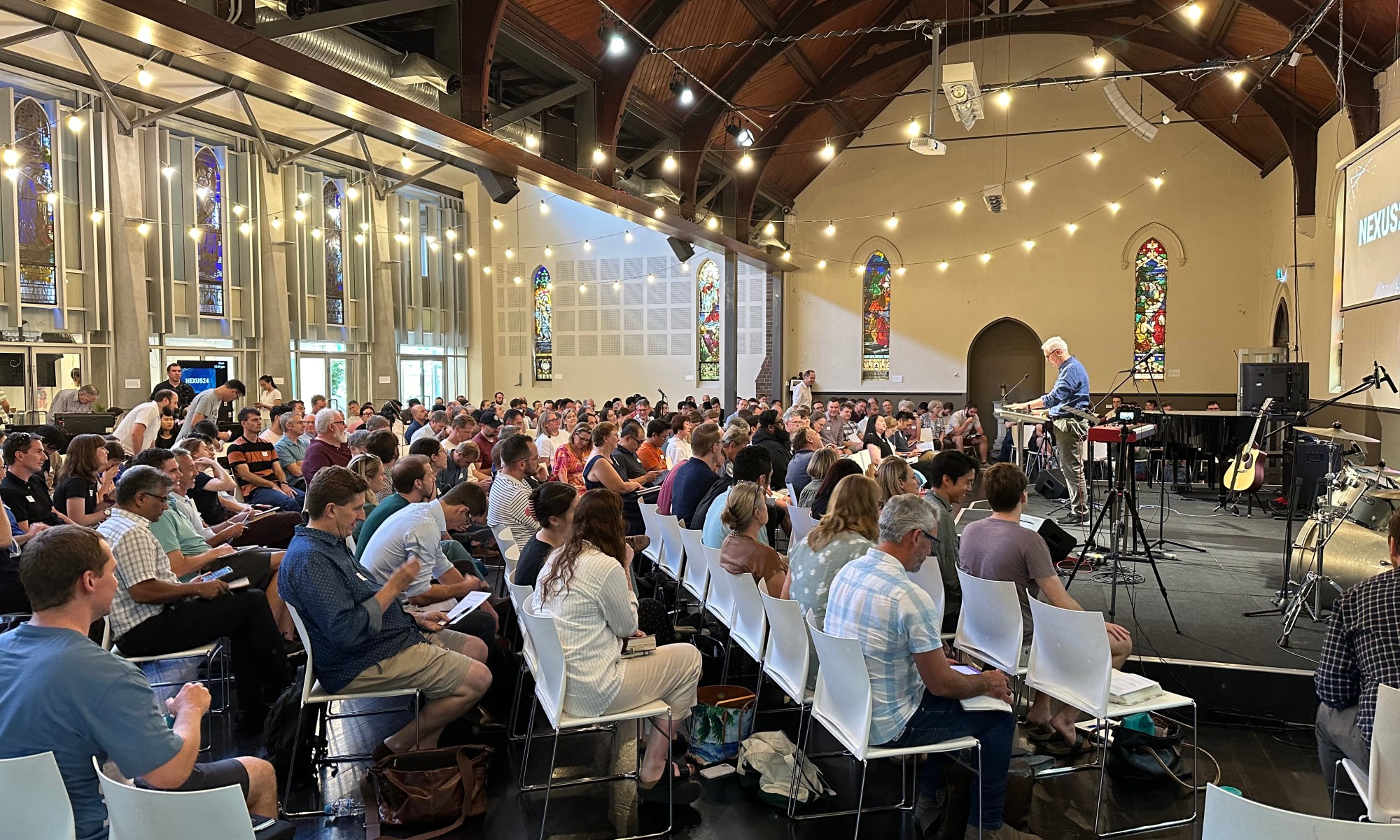

I wrote this article in response to a talk I heard at the Nexus conference – which I found very enlightening….The original was on AP here
Closing the Gap – A Better way to Connect Bible and Practice
Presbyterian, Anglican or a Third Way?
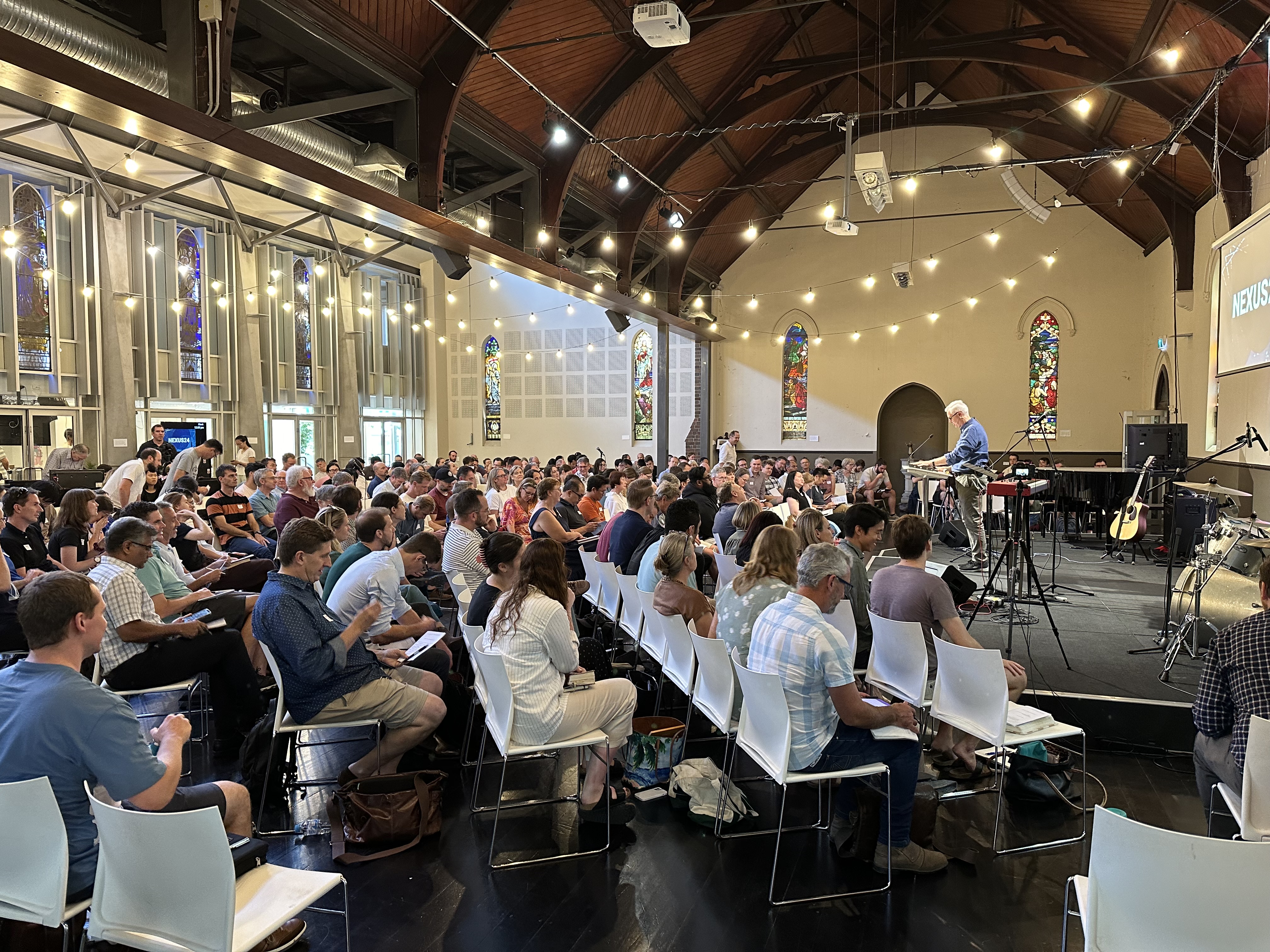
Tony Payne is a fascinating thinker, stimulating writer and gracious speaker. He is someone I have come to appreciate more and more in Australia – so it was with a sense of anticipation that I went to hear him (along with the other speakers) on Monday 11 March (2024) at the Nexus Conference in Sydney.
Tony’s talk was entitled ‘Closing the Gap: A better way to connect Bible and practice”. It was thought provoking, challenging and deep. I would recommend your listening when it is released on video. I won’t review every aspect of it, but there was one rather large area where I disagreed.
Tony’s argument was that the regulative and the normative principles both had good things to offer, but also serious difficulties. He defined the regulative principle as “God regulates the public worship and discipline of the church in a way analogous to his temple/worship laws for Israel” and that if something is not commanded, it should not be done. The normative was defined as “God has given various general principles or norms by which public worship and discipline should be framed. But as to the particulars of its arrangement at various times and places, these may be decided according to reason and godly tradition. We should act not contrary to Scripture”.
He then suggested a third way which he called the apprenticeship principle. It’s worth quoting in full his definition: “As we seek to apply theological truth to practice in our own circumstances, we are called to apprentice ourselves to how the biblical text does the same – how it reasons from theological truth to practical application (with regard to congregational life and ministry and everything). We should neither seek to recreate exact apostolic practice, nor cherry pick their theological principles, but learn to deliberate towards action how they did, growing as we do in the mind of Christ”.
Who would want to disagree with that?! Not me.
But, at the risk of being excommunicated from my former employers, Sydney Anglicans, can I suggest that the great benefit of Tony’s talk was its perceptive critique, as only an insider could, of Sydney Anglican practice. The 350 attendees at the conference were largely Sydney Anglicans – I’m sure I wasn’t the only Presbyterian – but it felt like it! Broadly speaking most Anglicans, and certainly Anglican polity, goes for the normative approach. Let’s look at that first – before coming on to the regulative.
The Anglican (Normative) Approach
Tony suggested that churches often adopted programs like Total Church, Evangelism Explosion and other church models without thinking about them theologically first. My observation would be that he is largely correct. Too often people assume that because they have a Moore College degree, they must be theologically sound (along with the corollary that those who don’t are somewhat suspect!) and that therefore they can just get on with running the church, doing the evangelism, preaching in the way that they see fit, or that other, equally sound people, see fit.
Tony also warned that some were in danger of falling into the trap of thinking that in the 16th century, and indeed in all centuries up to the present one, we could apply the Bible because it was largely a similar situation. But now the soil has changed and so we in effect need a new hermeneutic. I believe this was the key and most helpful point of his whole address. We are in great danger of taking this approach – which denies the sufficiency of the Scriptures for our contemporary culture.
He also suggested that the normative approach was like a hands-off boss, who gives you the task and does not give you specific instructions. I wasn’t sure, but he seemed to be accepting that there were no specific commands/regulations on worship in the New Testament. Whilst it is true that the temple worship has gone (not least because the temple has!), it is not correct to say that there are no commands/regulations on worship in the New Testaments. For example, we are told to ‘speak to one another with psalms, hymns and spiritual songs’ (Ephesians 5:19). Some will argue that this has nothing to do with public worship and so churches who do not for example use psalms, are not disobeying Scripture.
But therein lies a massive issue for Sydney Anglicans – following the Broughton Knox ecclesiology of worship, they in general deny that there is such a thing as ‘public worship’. When I told a leading Sydney Anglican that I had been worshipping God in church the reaction was such, that I thought I had denied the Trinity! ‘Worship is everything we do’. That’s true – or should be true. But there is also a specific public worship which the Church does.
The trouble is that in reacting to a High Church approach I believe that Sydney Anglicans have thrown out the baby with the sacramentalist bathwater, and in denying the theology of public worship, have ended with a normative approach bordering on Sandemanianism, which relies on programmes, structures and the latest sociological insights and worship trends – and incidentally destroys the concept of the Lord’s Day and runs the risk of sowing the seed of decline in Sunday attendance on public worship – but that’s a subject for another day! The irony is that in adopting the normative principle we can run the danger of being just as regulated and stuck in the same style as the strictest of the strict Presbyterian churches. Why else are the majority of Sydney Anglican churches similar in style and format? If Scripture isn’t giving us the regulations for public worship – who is?
The Presbyterian (Regulative) Approach
Whilst some Anglicans may also lean more towards the regulative approach, it is difficult to see how any Presbyterian who accepts the Westminster Confession could not take the regulative approach. “The acceptable way of worshipping the true God is instituted by himself, and so limited by his revealed will, that he may not be worshipped according to the imaginations and devices of men, or the suggestions of Satan, under any visible representation, or any other way not prescribed in the Holy Scripture” WCF 21:1). But does that mean we are in the position Tony described in his talk? As Paul would say ‘May it never be!”
Where I think Tony went wrong was in his definition of the regulative principle.
The terms, regulative and normative, are themselves somewhat loaded and dated. Most of us today would prefer to be seen as ‘normal’ and not ‘regulated’. But if I phrased the debate in another way, it looks somewhat different. The regulative principle asks: ‘What does Jesus tell us to do’, whereas the normative asks: ‘What does Jesus tell us not to do’, I.e. ‘What does the Lord want?’ versus ‘what can we get away with?’!
Tony spoke of the regulative principle as being bound by regulations as though the boss was looking over your shoulder. He argued that the regulative principle people saw it as the same as the Old Testament commands. But they didn’t. Again, using the WCF – chapter 19 tells us that the ceremonial law has been ‘abrogated’ – and there is no equivalent in the New Testament. In addition to this chapter 20 on Christian liberty is very strong that we cannot be bound by others traditions; and chapter 21 ‘Of Religious Worship and the Sabbath Day’ sets out the main elements of Christian worship, but does not establish a New Testament ceremonial law. This was the key flaw of Tony’s paper. He was in effect arguing against something that very few people argue for!
But having said that I now realise that in effect I agree with Tony’s position, if not his definitions. His third way, ‘apprenticeship’, is in fact the traditional Presbyterian and Puritan understanding of the regulative principle. God has given us basic theological insights into his nature, part of which is his concern to be worshipped in Spirit and truth. We are to apply these theological truths, commands and principles in the context in which we find ourselves. Tony implied that those who held to the regulative principle did so with a limited view of how God speaks – only through commands. But again, this is not the case. Beauty, story, poetry, indicatives as well as imperatives, are how the Lord speaks. It’s also how the Puritans wrote! It’s not those who hold to the Puritan view of Scripture, church and public worship who see the Bible as only a book of commands, or a series of doctrinal lectures.
Back in Scotland, I took my job in my hands when I argued that the Free Church should change its position from exclusive psalmody to inclusive psalmody. I did so because of, not in spite of, the regulative principle. After all, God has commanded us to sing psalms, hymns and spiritual songs. Ironically, the majority of arguments against were not based on the regulative principle, but the normative (at least for the Free Church). ‘This is not what Free Church people do’; ‘this will cause division’; ‘this will lead to confusion’; ‘now is not the time’…. etc. ‘This is our distinctive’.
Presbyterians often get the regulative principle wrong. Some fit Tony’s caricature and end up with well-meaning but still inconsistent regulations. In Scripture we are not commanded to meet in buildings or wear dog collars – but try being a Free Presbyterian minister and deny these in practice! We get confused about the difference between elements (in effect the essential things that God has commanded – like prayer, singing, preaching) and circumstances (time of meeting, use of electricity…how often should we meet on a Sunday etc). And we too often assume that just because we say we hold to the regulative principle, that all our traditions and practices are just what Jesus commanded. This is a denial of the ‘always reforming’ principle of the Reformed Church. But when we do reform – we must do so according to the regulative principle. Those who adhere to the regulative principle of ‘Christ is Head of the Church and so we should do what He says’ are the real radicals. And must be prepared to pay the cost that involves.
Perhaps it would be better to accept what Tony call’s the apprenticeship model; but recognise that it is in effect the Lordship model of the regulative principle. Who is the Head of the Church? Jesus Christ. Instead of remodelling ‘our’ mission statements, to better reflect where we, or our culture is, perhaps we should simply ask Him what His mission statement for His church is? I once heard a sermon in which the preacher envisaged Jesus walking down the aisle of our church during a worship service, gesturing and asking “Who told you to do this? Did I ask for this?”. Maybe Australian Anglicans and Presbyterians alike should put on a wrist band, WWJW – ‘What Would Jesus Want’? And then we would have to think theologically, biblically and culturally about all our practices!
Thanks for that interaction David. Tony’s talk can be viewed here:
share=copy
I have always liked the silent reverence present before many Free Church services start. Fun and camaraderie can come later! It feels akin to the quiet before a rugby kick off, where both teams have full focus and expectancy. There are maybe two observations. Sunday worship in many city churches draws very few people. I encounter lots of people who far prefer a smaller midweek meet up, often without a minister, just ‘pray-sing-scripture’. Others believe with sincerity but study the Bible at home, as well as slotting in occasional communion services. The Book of Acts Church seems to have done rather well with ‘home groups’! More formal evangelicalism has often been killed by the business model. The number of extreme and headline cases alarming. Yet that ethos possibly pervades a lot of Churches. After coming to faith as an adult, the most sneeringly negative response came from an in-law, who was a ‘pay your way in’-‘money on the Sunday plate’-person. The cultural part of faith (suit, donation envelope, doorway handshakes, respect for minister/elders etc) held sway. Yet underneath this was utter contempt for salvation and morals.
So interesting and thought provoking. As a Scot who migrated and was a Sydney Anglican for 12 years and now in a small independent church back in Scotland I find the different ways to do church and how wedded people can be to them fascinating. And yes Tony Payne is a great and accessible thinker and teacher. Thanks so much for sharing David and I trust that Newcastle is working out for you
Thanks for an interesting discussion David. I suspect in one way or another we are all ‘normative’ putting our traditions above what Scripture may teach. I think another aspect that must be taken into account is the development of church through the NT. Church in the second epistles seems a good bit different from church in Corinth; the freer Spirit led worship seems to give way to a more structured worship.
Fast forward to the present and this tension between a free movement of the Spirit and a more structured (Spirit embued) worship is evident – charismatic vs highly structured churches. It seems to me a middle way is preferable. One man doing everything publicly seems to me to stifle the Spirt while an uncontrolled charismatic worship misplaces the Spirit. Rather than regulative or normative perhaps we may want ‘principled’ . Here church polity and worship takes into account subtleties of Scripture perhaps more accurately.; to go beyond a revealed practice is one thing, to ignore revealed principles is another.
I enjoyed reading your critique as well as listening to Tony’s talk. I grew into my faith as a young woman within the Sydney Anglican tradition but was raised within a traditional Presbyterian family tradition and to add extra confusion went to a Catholic High School and University. I participated in Evangelicalism Explosion training and outreach events in Sydney. I was young and impressionable and took it all on board. Once leaving Sydney our family participated in Sydney Anglican style independent church plants in the Hunter. Eventually I began to see the Moore systemic approach to church and evangelicalism as being very prescriptive and catering mostly to new converts but often overlooking feeding and equiping the saints to live a purposful life outside of formal ‘evangelism’ .From my perspective I saw a lot of burnout and disappointment. You may be correct in your point about ‘throwing the baby out with the bathwater ” comment, although my understanding of BK ecclesiology is along the lines of whenever Christians meet together purposefully that is church not just Sunday worship. In my opinion the Presbyterian approach seems to unwittingly encourage the Sunday Christian approach. At times I find it quite lonely and sometimes feel alienated within the patriarchal style Presbyterian system. I tend to think all churches who have their roots in the Reformation need to honestly critique their way of doing things regularly in order to reveal any blind spots and investigate any need for reform. Im hopeful and thankful for Tony’s research and your reflection, insights and discussion points. It has given me a lot to think about.
Marg Mowczko is a Sydney Australian believer and a committed egalitarian. Is committed egalitarianism strong among Australian evangelical?
https://margmowczko.com/
Not in Sydney Anglicans – most of the rest in Australia are liberal…