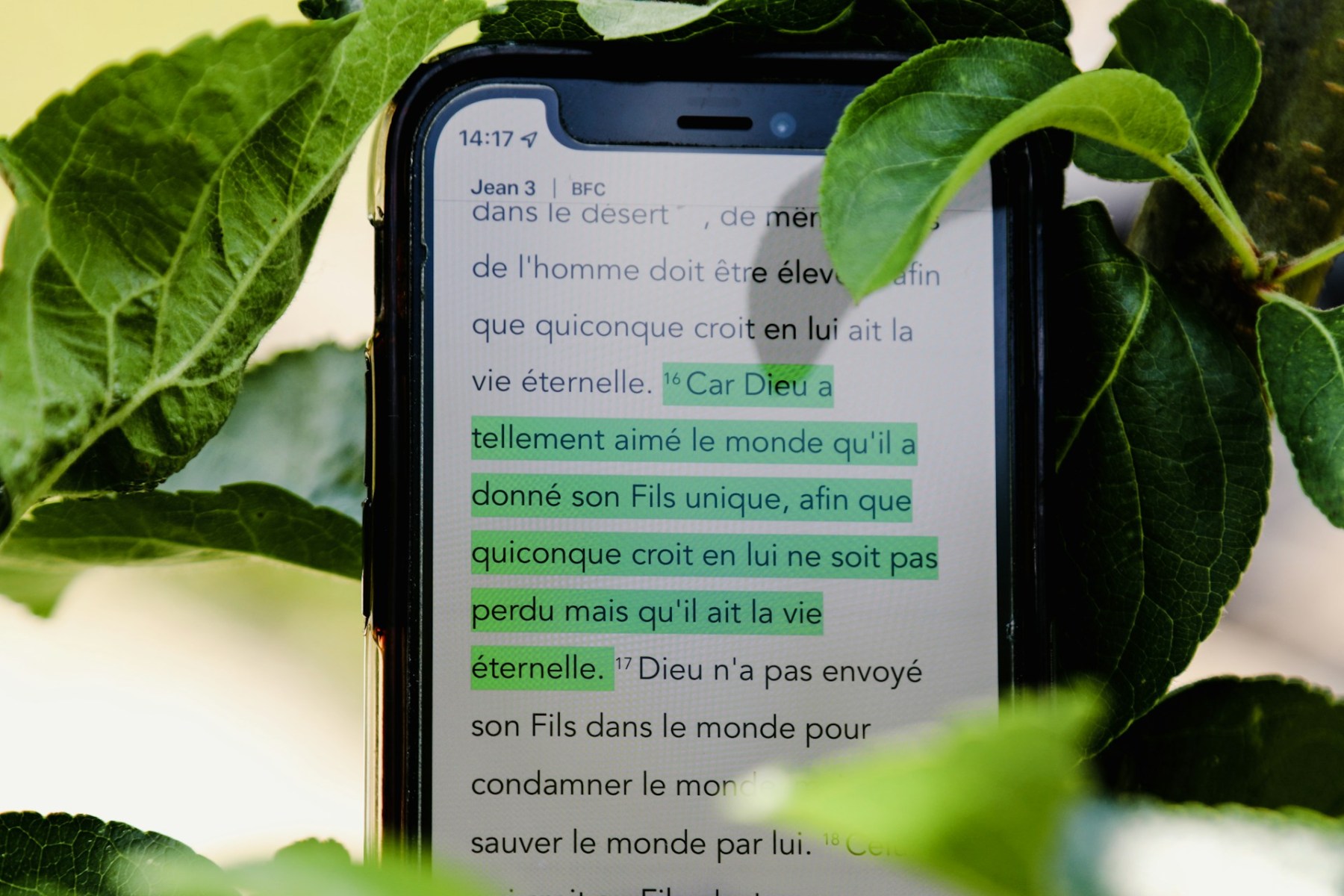

SEEK 23 – The iPhone Bible
Question: Some people say the Bible on the phone is not a good Bible that it is fake, but the Bible in hardcopy is the real Bible: is that true? Also, is KJV the only true Bible?
Bible Reading: Revelation 22:18-21
Text: “I warn everyone who hears the words of the prophecy of this scroll: if anyone adds anything to them, God will add to that person the plagues described in this book. And if anyone takes words away from this scroll of prophecy, God will take away from that person any share in the tree of life and the Holy City, which are described in this scroll” (Revelation 22:18-19)
There are pros and cons of having your Bible on your phone. I do. And it’s wonderful for looking up verses, reading on the train and listening to on my headphones. However, there are disadvantages as well – the most serious of which is that we all have a tendency to skim read on screen. Which is precisely the opposite of what we were talking about in the last chapter – we need to go deep into God’s word. So, I would argue that it’s much better when you are doing your normal reading to have a physical copy in front of you.
As regards your question it’s important for us to understand how we got the Bible. It wasn’t given to us in printed books as we now know. The printing press was only invented in Germany in the 15th Century. The first Bible printed on it was called the Gutenberg Bible. Before that we had the Bible on manuscripts and scrolls. The story of how the Bible came down to us through thousands of manuscripts and copies is quite remarkable. I would suggest you read F F Bruce’s The New Testament Documents – Are They Reliable?
The basic summary is that the Holy Spirit inspired human beings, who wrote down what happened and what he inspired in them. The church accepted the Jewish Bible – what we now call the Old Testament – and then the writings of the apostles – who were appointed by Jesus to be his witnesses and to carry his word. That’s how we ended up with the 27 books of the New Testament – the gospels, the letters and Revelation. Contrary to myths popularised by Dan Brown’s The Da Vinci Code, it is not the case that the Church just made up the Bible in the 4th century. As the church grew there were lots of fake gospels and letters which came into circulation. What the church did was formally recognise those which were apostolic and from the beginning – and then excluded all the fakes.
Ironically, I think that if we had had the Internet then it would have been far easier to corrupt the original text. Hard, handwritten copies are much harder to alter. But that does not mean that the Bible you have on your phone is not the real Bible. It’s quite easy for people to fake and corrupt things online – but it is also easy for you to check. So, the NIV Bible I have on my phone is exactly the same as the NIV Bible I have on my desk.
Is the King James Version the only true Bible? No. The KJV is a fine version of the Bible, but it is not the original version. It is an English translation from 1611. The Bible was written in Hebrew, Aramaic and Greek over 1500 years earlier! The Lord did not wait until 1500 years after Christ to send his word to us! We must be really careful not to add to the word of God.
But when people say this what they mean is that the KJV is the best translation based on the best manuscripts. There is a lot of argument about the manuscript traditions – but I won’t bore you with that somewhat detailed and technical textual argument. Suffice it to say that most versions of the Bible are based on the same original texts. As regards translation I would not use the KJV. Why? Because neither you nor I speak 16th Century English. And the language has changed a lot. We should read the Bible in what the Westminster Confession calls ‘the vulgar tongue’. ‘Vulgar’ in 16th Century English does not mean rude (this is a great example of how language changes) – it just means common or normal.
If English is your mother tongue, then get a good and accurate English translation (there are many); if you speak German, Swahili, Chinese, Spanish, Swedish, Arabian or any of the other 7,100 languages in the world – then get a Bible in your own language. The Bible has been translated in full or in part into 3,324 languages – which covers about 97% of all people. About 80% have the Bible in full. Organisations like Wycliffe Global Alliance https://www.wycliffe.net/are working on translating the rest. Perhaps one day you might be able to help them?!
Consider: Have you ever thought how amazing it is that God’s word has come down to us intact and unchanged? Or that almost all the world’s population now have access to the word of God in their own languages? Or that modern technology makes it even easier for us to read and hear God speak to us?
Recommended Further Reading:
The New Testament Documents – Are They Reliable? F F Bruce
Prayer: Lord, we thank you that you are the God who speaks. In the past you spoke through the prophets and many wonderous signs, but in these last days you have spoken to us by your Son. We praise your Name that Jesus is revealed to us in the Scriptures and that we have them in our own language. We pray that you would enable us to read them and to be doers as well as hearers of the Word. Keep us O Lord from adding to your Word, or taking away from it. In Christ’s Name. Amen.
SEEK 22 – Where to Start with the Bible
Hi David, I read various versions when studying but, my KJV I’ve had for years, has lots of notes, I know my way around it and, it’s been re-backed three times…
I always refer to the Interlinear for both Old and New Testaments…
Thy word is truth..
I feel like this about my NIV, I’d ideally like to switch to ESV, but I’ve too much invested in my NIV.
The NIV is way better than the ESV for both personal and public reading…
Hello David.., a very good and detailed exposition of the Holy Bible (My 2nd cousins in NI argue that the KJV is the ‘only’ true translation , however I will have further discussion with them after reading your excellent Seek 23..!
The K’oran was written firstly in Arabic, thus the Arabic version of the Holy Bible could be placed around the 21 or so, Arab nations of the world…
Sometimes it is difficult to achieve the same meaning in English as the original Hebrew, Aramaic or Greek text, as the translations are similar, however not exact.., a bit like synonyms displaying similar meanings..!
I wonder when the last ‘people nation’ (of which there are apparently 21,000) will be reached with the gospel, this being an indigenous race deep in the Brazilian rainforest, and where apparently it is more than challenging to reach by any means, land or air..?