


WHAT’S THE CHRISTIAN VIEW OF SCOTTISH INDEPENDENCE?
‘I was, I think, the last speaker, and after dwelling on the encroachments made by the Court of Session, confirmed by the final judgement of the House of Lords, and on the manner in which we had been treated in Parliament, where the voices of the Scottish Members had been altogether overborne by the English majority, I said, on the spur of the moment, that such injustice was enough to justify Scotland in demanding the repeal of the Union. With that, to my surprise, and somewhat to my consternation, the meeting rose as one man, waving hats and handkerchiefs, and cheering again and again. No doubt the enthusiastic feelings of the people assisted our object, but I took care not to speak of repeal of the Union at our subsequent meetings.’ *

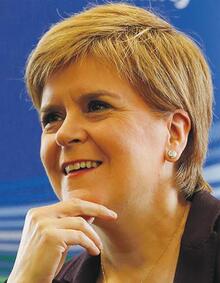
At the end of November 2022, the UK Supreme Court ruled that the Scottish Government did not have a unilateral right to hold another independence referendum. This was in response to a case brought by the Scottish Government which sought to circumnavigate the clause in the Scotland Act which requires, under Section 30, an agreement from the Westminster Parliament for such a referendum to be held. In 2014 such an agreement was given and a ‘once in a generation’ referendum was held which although eventually clearly won by the Unionists was nevertheless far closer than had been anticipated.
Given the court ruling, I think it is highly unlikely that Scotland will have another such referendum within the next ten years and unless there are exceptional changes (which given the current state of flux in the world may be likely) I do not expect Scotland to become independent in my lifetime. There will be lots of noise, lots of argument, lots of speculation, but things will largely remain the same.
What does all this have to do with the church? Should evangelicals in the United Kingdom have an opinion? What does God have to say about all this?
Some Christians think it is obvious – Christianity is for freedom, and it is good for a nation to be free. ‘Know the truth and the truth shall make you free’ (John 8:32). Others argue that it is wrong to seek to change things – one man wrote to me, furious that I had voted for independence in 2014, citing Deuteronomy 19:14, ‘You shall not move your neighbour’s boundary mark, which the ancestors have set, in your inheritance which you will inherit in the land that the Lord your God gives you to possess’. It’s not helpful when Christians quote Scripture out of context in order to support their own political views!
Another doctor told me that Britain was the lost tribe of Israel and the British throne the eternal throne promised to Israel! Without going to that strange extreme, it is true that one of the founding pillars of the Union of the United Kingdom was Christianity – specifically Protestant Christianity. Perhaps it will be the case that the removal of that pillar will result in the disintegration of the UK?
In a world where politics has replaced religion for many, it is disappointing when Christians fall into the trap of tying their Christianity in with their politics. Of course, our Christianity will influence our political views, but the notion that there is a specific Christian political view is unbiblical. I am really surprised at how many people treat this as a moral and doctrinal issue. During the 2014 referendum several people wrote to me and said that I was going against God’s word because I am for divorce (I struggle to see why the Bible’s teaching about divorce and marriage has anything to do with constitutional arrangements of nation states), that I am playing into the hands of the secularists, and questioned both my intelligence and my spiritual condition.
Today I don’t think I would vote the same way as I did in 2014. With the increasing soft authoritarianism of the SNP, the desire to leave one Union only to join a larger one, the way that the Scottish Government now governs, with its increasing incompetence and authoritarian progressivism, I now look back on 2014 and think that we not only dodged a bullet, but we also dodged a bomb.
None of this is to argue for my particular political position – I would like an independent, republican Scotland out of the EU (which makes me even more of a minority in Scotland than card-carrying Calvinists!) – but rather to point out that Christians can hold to different political views without demonising each other, not least because we know that the ultimate need of our country is not to be met through political solutions.
In my former congregation, St Peters Free Church in Dundee (founded after the Disruption in 1843 mentioned at the beginning of this article), there was a wide variety of political opinions, from Northern Irish unionists to a former leader of the SNP, from Tories to socialists, from Liberal Democrat to Green. In another congregation I had an elder who was a fervent Labour supporter, another a Conservative and yet another a Nationalist. We all lived and worshipped (and argued!) together as brothers and sisters in Christ. Is that not the way it should be? Let’s not make the divisions of politics a cause of division in the body of Christ.
* Annals of the Disruption; consisting mainly of extracts from the autograph narratives of Ministers who left the Scottish Establishment in 1843. Rev. Thomas Brown. Published by Maclaren and Macniven, Edinburgh, 1878.
A Positive Case for Real Scottish Independence and a New Political Party
The End of Scottish Independence?