

Dear brothers and sisters,
We are in a state of panic here in Northern Sydney. After weeks of no community transmission – as of the time of writing we now have 68 – and this number is likely to go up. The virus probably came in through an air crew from the US a couple of weeks ago. The next couple of days will see whether NSW’s much praised ‘track and trace’ system will be enough to contain the spread. But walking around this weekend there is no doubt that there is a palpable sense of fear. You can feel the panic. Of course, dramatic headlines and doomsday predictions from ‘experts’ keen to get their names in the headlines (‘doomed, we are all doomed unless you follow my advice’) – just fuel the increasing sense of impending apocalypse.
(Of course, I am aware that those of you reading this from the UK and US will wonder what the fuss is all about. 68 cases is nothing (and we have none of them in hospital and zero deaths). Meanwhile you are faced with the depressing cycle of lockdown, release, lockdown …until the vaccine kicks in. I feel your pain!)
Part of the problem is that we have believed the myth that governments can control this disease. Therefore if they don’t it must be someone’s fault. In fact, for many state authorities this has become like some kind of virility test. Above everything else they must be seen to be in control of Covid – everything else can be sacrificed to this goal. Don’t get me wrong. Covid 19 is serious and governments, churches, companies, local communities and individuals should do what we can to limit its spread and effects. The question is what can we do? And what are the cost/benefits of the measures that we take?
But even asking that question gets people outraged – they think it is callous to speak in such a way. But we do it all the time because we don’t live in a world where there is no disease, and no one ever dies. For example, there is something that governments could do that would save tens of thousands of lives every year. Should they do it? Of course – who does not want to save tens of thousands of lives? So why not reduce the speed limit to 5 miles per hour?
The trouble is that when people (and governments) panic and believe in their own power to control everything – they look for simple solutions – solutions which can be limited to a tweet and fed to a population whom our rulers think are incapable of thinking for themselves and acting appropriately.
And so to facemasks. A subject I have been reluctant to write about because I wanted to find out more before writing, but mainly because it seems to invoke a visceral reaction and is seen as a shibboleth test for your view of politics, life and morality. For some wearing a mask is seen as the mark of being a decent human being who cares for others and follows the science. For others wearing it is a sign that you are subservient sheep giving in to the dictates of an authoritarian regime. I find myself in despair that even something as simple as this can be so divisive – and even more so in terms of the simplistic slogans that are spouted as self-evident, all comprehensive facts. There is no room for nuance, or questioning.
I have been trying to read up on this – not least to determine my own behaviour. Should I wear a mask? Where? When? I have read numerous articles (and a couple of scientific studies) from many different angles and sources and to say the least the subject is confusing! This is what I have discovered so far.
-
Wearing a mask is now seen as a simple solution to the spread of Covid 19.
The politician Chris Christie writing in The Wall Street Journal makes the following point: When you get this disease, it hits you how easy it is to prevent. We are asked to wear cloth over our mouth and nose, wash our hands and avoid crowds. These minor inconveniences can save your life, your neighbours and the economy. Seldom has so little been asked for so much benefit. Here in Sydney journalists are asking why don’t you just mandate wearing masks? They ask it is such a way that they may as well just add “you heartless idiot’ at the end of the question. After all wearing a mask is the sensible and simple thing to do.
But as Anders Tegnall points out.
“Face masks are an easy solution, and I’m deeply distrustful of easy solutions to complex problems”
Of course this does not stop politicians making unscientific claims in the name of ‘the’ science. Joe Biden for example claimed that wearing masks would save 100,000 American lives by the end of the year and would be the means to getting us back to a ‘normal’ life. Not ‘might’, nor ‘could’, but ‘would’. There is little evidence for that remark – at best it is a series of unproven assumptions which are only as reliable as the imperfect information fed into the model. Of course, the more apocalyptic the better – for the headline writers and the politicians seeking to influence others behaviour and justify their own.
2) Masks can help but the Scientific evidence that masks substantially prevent the spread of Covid 19 is limited.
There have been very few peer reviewed studies on the subject. The assumption is that because Covid 19 can spread through airborne particles anything that reduces the spread of those will reduce the spread of Covid must work. The trouble is that most people work on the assumption that masks are a barrier, when they are in fact a filter. The only really effective filters are surgical masks which are not designed to be worn outside the operating theatre or for long times.
The largest controlled study is the Danish one – which because of its results had difficulty getting published. Its scientific conclusions did not suit the general establishment consensus and it was feared that its publication would harm ‘public health’. So much for being led by the science!
The basic results of the Danish study are interesting. The headline result was that masks do little or nothing to lower the infection rate – for those who wear them. Those who wear masks because they think it will protect them are just wrong. The main author of the study, Dr Henning Bundgaard, a cardiologist at the University of Copenhagen, “Our study gives an indication of how much you gain from wearing a mask: Not a lot.”
However, the key issue is whether they prevent spread. As far as I am aware have been no peer reviewed empirical studies which demonstrate that. Wearing masks appears to have done little to prevent the surges in countries like the US, Italy and the UK.
But even if the evidence is limited and at best only suggests that wearing masks may be a factor in helping prevent the spread – even if it saves one life, surely it is worth doing? After all there is no harm in wearing a mask is there? Which leads me on to the most surprising aspect –
3) Wearing Masks can also have a negative effect.
Psychological effects – There was the initial concern expressed by the WHO (until they were got at for political reasons and changed their advice) that masks encourage a false sense of security and will encourage people to think they are immune and ignore more effective measures like handwashing and social distancing. Irresponsible statements like that of CDC director Dr Robert Redford have not helped. “: “I might even go so far as to say that this face mask is more guaranteed to protect me against COVID than when I take a COVID vaccine.”We are encouraged to wear masks because it makes others feel comfortable. It also gives the sense of caring and that we are doing something. However, there is a negative psychological effect. We don’t get to see the human face. Why stop with masks that cover mouth and nose? A study published in The Lancet also suggested eye protection was helpful in stopping the spread of Covid. Why not wear protective glasses? What about hands? Should we never go out without surgical gloves? In fact, the safest thing would be for each of us to go out totally covered in plastic.


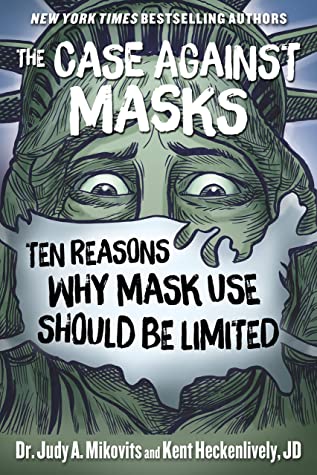

“The best-case scenario is that evidence that masks work is scarce. Common sense would seem to suggest that a strong case can be made for the use of masks to avoid respiratory droplets from individuals with respiratory infections. If you are displaying even mild symptoms, or worry that you might have been exposed, it’s probably a good idea to avoid contact with other people. If you are not sick, but going into a high-risk area, like hospitals, nursing homes, or a crowded store, the temporary use of a mask in those situations could be a reasonable response.”
“There is another danger to wearing these masks on a daily basis, especially if worn for several hours. When a person is infected with a respiratory virus, they will expel some of the virus with each breath. If they are wearing a mask, especially an N95 mask or other tightly fitting mask, they will be constantly rebreathing the viruses, raising the concentration of the virus in the lungs and nasal passages. We know that people who have the worst reactions to the coronavirus have the highest concentrations of the virus early on. And this leads to the deadly cytokine storm in a selected number.’
“There seems to be multiple factors that are critical in the spread of SARS-CoV-2 and the development of COVID-19. Different individuals, if infected, will expel different amounts of virus, likely due to the loudness of their speaking or singing, their closeness to other individuals, and the time they’re together. Cold temperatures are more likely to support the spread of the virus than warm temperatures, if only by increasing the possibility that an infected person will cough or sneeze. Sunlight is a potent killer of this virus. Another factor may be that even if infected there is a relatively brief time in which a person is more infectious. This time period can be enhanced by cold temperatures or lack of exposure to UV light. Does universal masking make sense when we consider all these factors? Actually, consideration of these factors suggests universal masking increases the risk of spreading the infection.”

Political effects – Now that masks have been politicised, they have become even more dangerous. Instead of being a matter of science and healthcare they have now become a political badge and belief in them has become a matter of doctrinal faith – not science. Sometimes this is just a matter of virtue signalling, but at other times it takes a more sinister turn. Camus declared “The welfare of humanity is always the alibi of tyrants.” In the name of public health politicians sometimes grab more power and curb civil liberties. You can see this in so many ways – the police who arrest you in Victoria for not wearing a mask when you are walking in the open air on your own. The pastor in the US who was arrested after being reported by a neighbour for not wearing a mask when he was sitting in his church on his own without a mask. The politicians who go on camera with a mask, even though they are not within 2m of anyone and immediately take it off as soon as they are off camera. In addition to this I find the mandating of wearing masks in church an abuse of governmental authority and an unnecessary intrusion into the public worship of God. Governments can advise and churches can choose to follow that advice, but the government telling us what we can and cannot do in public worship is a step too far.
The book I mentioned above appears to have now been banned on Amazon. It’s not enough to ‘follow the science’ – you have to follow the politically acceptable science. Which of course means that it is not science at all – because the very definition of science means that it must be falsifiable and open to question. Once the big media corporations start telling you what science is acceptable and what is not then science has become corrupted. Every politician now has it as part of their mantra that wearing masks is the thing to do, and to question mask wearing puts you in the same category as a holocaust denier, a climate change denier and a flat earther even if you are a scientist such as Dr Simon Clarke, associate professor of cellular microbiology at the University of Reading who recently wrote: “I don’t think masks are all that great at stopping transmission in either direction. The decisions to change policy were made by politicians. It first happened in Scotland where Nicola Sturgeon stood up and said she thought they were needed. Then Boris Johnson said he thought there was evidence for their effectiveness. I’ve yet to see that evidence. I’m not entirely sure that I’ve been convinced. But that ship has sailed, in many respects”.
Conclusion:
So where does that leave me? I hate wearing a mask, but will do so when mandated (like entering the Apple Store, or if I have to in order to go to church). If the government makes it illegal for me to go out without a mask, I will wear it – under protest. I would wear it on public transport if I am in a crowded situation. I won’t wear it to show I ‘care’, but I would if I was in a culture where not to wear a mask would be considered impolite. I would wear a mask if I had any symptoms or thought I had Covid – but then I wouldn’t need to, because I wouldn’t go out and certainly would not be in touch with other people. Today when I go to work, I will respect the government’s request not to go on public transport without wearing unmasked – by not going on public transport. I will cycle to work and breath freely!
Hopefully see you next week. Have a great Christmas – remember Boris and Nicola can’t cancel the real Christmas. May you know The Light in the Darkness,
David
PS. Here is another article which I found really informative – https://www.aier.org/article/the-year-of-disguises/
Letter from Australia 72 – The Photo and Wedding of the Year!

