


In the previous article we looked at the place and motivation of evangelism in the Church. https://ap.org.au/2026/10/22/evangelism-in-the-presbyterian-church/
Now I want to turn to a subject that some would regard as almost irrelevant in the subject of evangelism. How is the church run? In other words, we are going to look at Evangelism and Ecclesiology.
What does that have to do with evangelism? What does evangelism have to do with the church? Luke 24:46-49 and Matthew 28:18-20 are amongst the New Testament passages that make it very clear that evangelism is to be done by the Church – in fact I struggle to think of any verses which speak of the lone evangelist – or the evangelist without a church? I think of one evangelistic organization whose response to my suggestion that they should really work with the churches, and that the churches should be doing the evangelism, was that the churches don’t know how to do evangelism. Evangelism should be left up to the experts! That’s an appalling way to think because it separates evangelism from discipleship, which in terms of Matthew 28, is an unbiblical and ridiculous thing to do.
I think of another church I knew in the Southern United States, in the heart of an inner city, which was more than 60% African American. And yet, the only Black people in the church of several thousand were African students from a theological seminary and staff who worked in the daycare centre or in providing food. When I asked them about this, they said they did evangelism through Evangelism Explosion that had lots of people coming to faith, but none of them came to their church. They tried to encourage them to go to the Black churches. Is that really biblical evangelism? We make disciples by baptising people into the church and teaching them to obey everything Christ has commanded.
So, when we say the church does evangelism, what do we mean? As in my previous article, I’m arguing that evangelism should be within the DNA of the church, and that includes within its structures. Therefore, it is extremely important to ask how our church is governed.
What kind of church are we? Are we a staff-led model? the 5 M’s model (magnification, membership, maturity, ministry, mission)? the ministry team model? the church service model? the purpose-driven model? The mega church attractional model? The small group model? It seems that, like coffee varieties, there now exists a seemingly endless choice in the church model smorgasbord! I am not trying to be facetious, but when I am asked this question I just simply state we are Presbyterian.


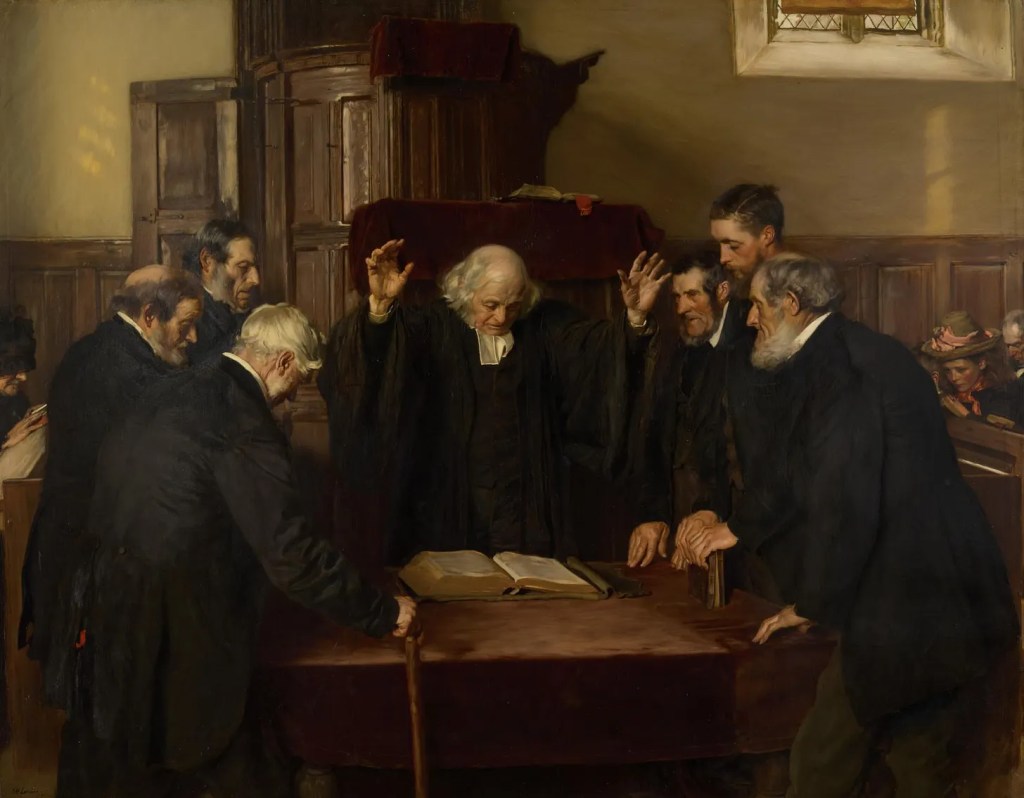
(John Henry Lorimers – Ordaining of Elders)
I recently listened to a talk from Philip Jensen in England where he put it rather well. He stated that the only offices he could find in the New Testament were those of elder and deacon, and he wasn’t sure what a deacon was! I think the Presbyterian model is essentially the biblical model. The local church is run by elders and deacons, and these local churches cooperate together in what we call Presbyteries and General Assemblies. (Acts 20:17 and 28; 1 Timothy 3:1-7, 1 Peter 5:1-5, Acts 6:1-7, Philippians 1:1, Romans 16:1).
In my view, when you deviate from this basic biblical model and create a church which has a hierarchical structure, or is run like a corporation, or is a personality cult, or a social club, evangelism is greatly hindered.
The Best of Churches, the Worst of Churches
I’m not here to argue the values of Presbyterianism as over against Anglicanism or Independency. But I do want to suggest that Presbyterianism is both the best of worlds and the worst of worlds. I think it is the best of worlds because it is essentially biblical. But it becomes the worst of worlds when the biblical structures are run in an unbiblical way, by unbiblical people. If it becomes bureaucratic, so that the church is run by accountants and lawyers, then we are in trouble. I have no desire to disparage to accountants and lawyers. We need them in this world – but there will be no jobs for them in heaven. Sadly, Presbyterianism, with its church courts, its general assemblies, and its codes, can be a paradise for amateur (or real) lawyers who want to argue what the code says, not what the Scripture says.
There is a danger that the Australian Presbyterian Church could drift away from its Presbyterian roots, and be greatly influenced by models which work well within Independency and Anglicanism, but are not well suited for biblical Presbyterianism. We can learn from these models, but we need to adapt them to the particular strengths of our own system. The methodology of elders governing a local church, looking after the spiritual side of things, and deacons looking after the material and social side, is a simple but remarkably effective and cross-cultural one.
Problems occur when we become a church that gets run by committees rather than elders and deacons or deaconesses. We end up creating lots of extra posts, which are, in effect, extra offices. It’s bad enough having a local church run by staff, but to have a whole denomination run by staff is the worst of both worlds. I noted in Scotland that as the churches declined, the number of Christian organisations, committees and bureaucrats seemed to increase. Why?
Evangelism and the Elders
What does all this have to do with evangelism? Evangelism is primarily done by the local church. The local church is governed by elders who should be spiritual, hospitable men, whose desire is to see the church not as an inward-looking enclave, but as an outward-looking home for the lost. If you have a church that’s run by elders who, as one elder told me, see their job as being to restrain the minister or to ensure that the traditions of the church are kept or who think that they are there as representatives for their own particular group or interest, then, as a church, you won’t do effective evangelism. But if you have elders who see that the role of the church is to look outwards and to proclaim the gospel to every creature under heaven, then that creates a whole different dynamic within the church. Evangelism is not then seen as a one-off event, which is done to assuage your conscience that you are actually evangelical, nor is it seen as a means to replenish empty pews that were full in days past.
I was once told by a pastor that his church services existed so that people could get into small groups. That is completely the reverse of what it should be. Our evangelism exists to bring the good news of Christ to all people so that they may serve him, believe in him, and worship him. Small groups can be a means to an end. The worship of God is the end.
In my view, every session of every Presbyterian church should have as an agenda item, evangelism. How do we reach the lost?
Numbers?
Now, there is an important caveat here. There is an obsession with numbers, which is unbiblical and even hinders evangelism. Those who argue, for example, for a 5% increase argue for that number because they see it as achievable, doable, and motivating. I find it depressing and demotivating. https://ap.org.au/2025/08/01/is-5-enough/
Five percent is no use to me. I live in a community of hundreds of thousands. In a congregation of 20, 5% would’ve been one person. That’s no use. In a congregation of 100, 5% is five people. That’s no use. Rather than having as an aim some arbitrary figure, either determined by an algorithm or by a well-meaning strategist, why don’t we have a biblical aim?
Communicating the Gospel to the Whole Community
We have the responsibility of Ezekiel (see chapters 3 and 33) to do our utmost to ensure that every person in our community hears the gospel. We cannot determine their response. Only the Holy Spirit will convict people. (John 16:8-11). But I’m absolutely convinced, as Isaiah says, that God’s word will not return to him empty. (Isaiah 55:11). So how do we get God’s word out? I am not responsible for whether people believe. I am responsible for whether they hear. I am to go into all the world and preach the gospel.
Now, this is not easy in today’s society. I question if it ever was. But the elders have to honestly ask themselves: ‘Is our church a church that can disciple people? Is our church a church that will welcome new people, especially those who are different from us? Could our church grow without falling apart at the seams?’ In decades of ministry, I’ve witnessed churches which have grown and blown up. I suspect that this is because many of our structures, both physically and organizationally, are designed for maintenance and survival rather than expansion, evangelism, growth, and discipleship.
A Full Evangelistic Quiver
I would also strongly advise any session against thinking that if they adopt this particular program or that particular program, they will then be able to do evangelism. Too often, that’s an opt-out. It’s an easy solution. It’s better to have several arrows in your evangelistic quiver! But you also need a church where newcomers feel welcome, where they sense the presence of God in public worship (1 Corinthians 14:25), and where the members feel liberated to invite people. Perhaps we should ask our people: ‘Do you invite people to church?’ And if not, ‘Why not?’
This is not an exclusivist mentality. We know that the Kingdom of Christ, and the Church of Christ is not just our congregation. A kirk session will consist of those who are prepared to work with other churches because our theology tells us that we are not the only church. (Ps 133) Christ’s Church comes in surprising forms and packages!
Dare to Discipline
Another surprising aspect of our ecclesiology that really helps is the question of discipline. Calvin regarded the marks of the church as being the preaching of the word, the administration of the sacraments, and church discipline. In traditional Scottish Presbyterian theology, that was taken up. Now, I wonder how many of our churches have discipline? (1 Corinthians 5:12-13) The point is that if we don’t – If we just have a collective which depends upon networks, people turning up, and just believing what people say or disbelieving what they say – then we end up with a limitation on our evangelism.
All evangelism should bear in mind the parable of the sower. (Matthew 13:1-23). There are people who just don’t hear the word. It falls on stony ground. There are people who at first hear the word with joy, but then it’s snatched away. There are people who hear the word, and I believe this is saying that they are converted in some sense, but they become choked. They don’t produce fruit, which kind of leaves them in the no man’s land of ‘Are they converted or not?’ Maybe they are, maybe they’re not. And then there are people who produce fruit 30, 60, and 100-fold.
How are we to determine which is which? We can’t. There are those who come, they appear to be brilliant, and we line them up as converts, part of our 5%. Yet within a couple of years, they have turned aside or slid away. There are those who come, who at first blossom and flourish, and yet as they get older, become bitter and withered. They become a thorn in the flesh of the body, rather than a living component which supports and helps others. (2 Timothy 4:10) This has implications for how we operate.
Unlike most independent churches, we don’t require our members to sign a doctrinal statement of faith. We don’t, as a church, vote on doctrine. We have our confessions. The elders must sign up to them. But you can become a member in a Presbyterian church and be a Pentecostal, an adult Baptist only, or an Arminian. If you are a Christian and love the Lord Jesus and are willing to work within the local congregation, you are welcome. We have open doors. There is no hurdle to climb except that of being a committed Christian.
However, if you, as part of the body, start disgracing the body, if you persist in godless behaviour, if you become a focus of disunity, if you start teaching false doctrine, then we should discipline you.
There are churches that operate a kind of open door in and an open door out. Biblically, we ought to have an open door in, but we ask that people believe before they belong. It’s not belonging before believing. People are welcome to come to churches, but they can’t become members in the church until they have a credible profession of faith in Christ. But once they become members, they are part of a community and a body. And for the body to work, for the body to grow, then there must be discipline.
What Kind of Membership?
In terms of membership, it is important that we understand the differences between a bare profession of faith, a proven profession of faith and a credible profession of faith. A bare profession is when someone simply states that he or she is a Christian, although there may not be an acceptance of basic Christian doctrines or an adoption of a Christian lifestyle. A proven profession is where you have to prove that you are born again. The former leads to anarchy in the church; the latter to legalism and hypocrisy. A credible profession of faith is one where your doctrine is not contradicted by your lifestyle. Of course, you may be a hypocrite and a very good liar – but in the course of time that will come out – and should be dealt with by church discipline.
Cultural Awareness
Any group of elders will also seek to evaluate the local situation, and have a macro, mecro, and micro awareness of the culture. By macro I mean an awareness of what is going on in the culture in general. By mecro (that’s just a word I made up) I mean an awareness of your local community and culture. And by micro, I mean the culture within the church.
Prayer
And of course, the first thing in evangelism is prayer. In our public and private prayers, the fate of the lost should come before the organ recitals. It was Derek Thomas, the Welshman in the US, who observed that much of the time in our prayer meetings are organ recitals – praying for Mrs Brown’s kidneys, and Mr Smith’s lungs. Praying for the sick is good – praying for the spiritually dead even more so. We can’t convert anyone, only the Holy Spirit can. And our Father in heaven will give the Holy Spirit to those who ask him.
And finally, Presbyterianism is not just the local church; we also have presbyteries and general assemblies. Let me say a little about each of them.
Presbyteries and Evangelism
Again, without question, on the agenda of every presbytery should be evangelism. I’m not a great believer in strategic plans, but sometimes it is good to have some kind of vision, and to prepare for growing churches. I think of my own Presbytery and believe that we should be asking ‘where are the next five church plants going to come from’?
The Assembly and Evangelism
Presbyterianism can be a help planting. When I went to a church revitalization in Dundee, I was promised I would get five years’ salary from the central denomination. That meant I did not have to spend much of my time fundraising. As the church grew and developed of course it ended up benefiting the wider church even more – as we became a net giver. In NSW we are about to decide what to do with the millions that are coming from the sale of aged care facilities. My belief is that as well as continuing to fund some kind of aged care ministry, we should also put a large sum into funding biblical evangelism – rather than just put the money aside for a rainy day or as an investment we can live off for a while. Instead of preparing for leaky barns, we need to be sowing seed so that we will have a crop to put in the barns!
As regards the General Assembly of the NSW Presbyterians, there is a committee which illustrates the problem (and the opportunities). The Ministry and Mission committee of the NSW General Assembly was an amalgamation of two committees – the Home Mission and the Ministry. The Assembly naturally has a great deal to say about ministry and passes a lot of ministry legislation – which the Ministry and Mission committee has to implement. As a natural consequence, mission gets squeezed out. As in many local churches the tyranny of the urgent drives out the vision of the eternal. We are all for evangelism but meanwhile ministers have to be paid, committees funded, laws complied with, and on it goes. People can make fine speeches at Assemblies … we can produce well researched reports … but without the structural and financial support, without the freedom to be creative and develop new missions and work – there is little chance that evangelism will be anything other than a nice sounding idea.
Which Vision
I leave you with one final illustration. When I attended the Free Church College in Edinburgh, I went to see the minister of a new church plant in Livingstone, Rev John Mackay. He wanted me to go out and help him whilst I was at college. When I went into his study, I noted a map of Livingstone and the surrounding area of West Lothian. There was one blue pin, and several red pins in the map. “What’s that?” “The red pin is our new church – the blue ones are the Presbytery of West Lothian”. None of those churches existed. But he had the vision. (The presbytery hasn’t quite arrived yet – but at least three of those pins are now real churches!) A few years later I was serving as an advisor on a Church of Scotland committee – whilst in ‘121’ (their HQ) I asked one of the leading members of staff about their plans for growth. “Oh – we don’t have plans for growth – we just have plans for managed decline”. I know which vision I prefer.
– David Robertson
This article was first published on AP here