


Over Christmas and Boxing Day it was good to have an internet and social media fast (and before I get the comments – yes blog posts continued – they were scheduled from last week!)…Did I miss much? Apparently not – the Brexitmania continued – with Lord Adonis, Lord Foulkes and Alistair Campbell tweeting with all the fervour of religious zealots throughout Christmas. The SNP of course could not miss the opportunity to make Christmas about Brexit as well – posting this cringeworthy twee video from Brian Cox.
Apparently in the UK the people must now be the judge – except in Scotland where there is another way – independence. The SNP are arguing against leaving a union (the EU) because of the economic costs. They are arguing against leaving a union even after there has been democratic vote to do just that. They don’t seem to realise that the arguments they use against leaving the EU, are precisely the same arguments that could be used for Scotland leaving another union – the UK – except in the case of the latter the argument is stronger (leaving a 400 year old union is going to be a lot harder than leaving a 40 year one!).
Meanwhile Leslie Riddoch wrote this extraordinary article in the Scotsman where she trashed Westminster and praised the ‘tenacious’ Macron, Juncker and Merkel. Yours truly had this reply published today:
Dear Editor,
Lesley Riddoch asks the question: “Can Scotland be a modern independent state within the EU?” (24th December). It’s a nonsensical question – like asking whether we can choose a square circle. A small country cannot belong to the EU and be independent – unless you define ‘independence’ as not being able to make your own fishing policy, trade deals, laws and control your own economy and democracy. Lesley may be right to mock UK political leaders, but when she lauds
Merkel, Juncker and Macron she is surely having a laugh?! And when she cites Norway as an example she seems to forget that Norway is indeed an independent state, because it is out of the EU.Whilst there is much to mock and despair of in the UK parliament, there is just as much to despair of in ‘progressive’ politicians and journalists who are blinded by the fantasy faith they have in the EU. Please can we have some realistic politics in Scotland that make sense?
Yours
Meanwhile if you are short of some reading here is an excellent article in the Australian – Eurocrats conspire to thwart democracy.
These in The Spectator were also enlightening – (both from Remainers – I try to be fair and balanced!)
https://blogs.spectator.co.uk/2018/12/the-nine-lessons-of-brexit/
And this in Politico from Quentin Letts also gave a more optimistic perspective…


But doubtless the brexitmania will continue as we are continually told that without the EU we are all going to die. Because apparently the only thing that stops Britain falling into fascism is the EU (and the Lords, political and business leaders and the celebrities who just all have ‘the people’s’ best interests at heart – bless ’em). This creeps in everywhere. Even in the otherwise excellent new BBC adaptation of Agatha Christie’s The ABC Murders, we are shown a Britain in the 1930’s which was full of racists and fascists…(the hardly subtle message seems to be ‘watch out or we will return to the 1930’s – conveniently forgetting that the people who are being mocked and despised are those who did actually fight fascism – many of them giving up their lives in the process.
But lets return to our review of The Great Deception.
Ch. 10 is even more fascinating because it deals with the lies, finance and manipulation used in the first referendum. It appears that things have not changed much!
Ch. 10 Britain Stays In – 1973-1975
“Do you think that the United Kingdom should stay in the European Community (the common market)?” Referendum question put to the British people, 5 June 1975.
“In 1975 I campaigned as a Conservative Parliamentary candidate for a yes vote in the referendum that kept us in the EC. In retrospect it is abundantly clear that I campaigned on a prospectus that was sufficiently false to ensure that, if the issue had been a public offer in securities, I would face prosecution under the provisions of the Companies act and I would lose.” Tom Benyon, The Times, 29 May 2003
The first experience of many British people of belonging to the Common Market was the introduction of VAT, one of the most bureaucratic taxes ever invented by government. It’s big advantage was that for the first time millions of businesses would have to act as unpaid tax collectors, charging their customers 10% and the cost of all goods and services supplied, then subtracting all the VAT paid to their own suppliers and items not “zero rated” or exempt, and sending the difference to the government. It was of course also a great disadvantage the poor.
As a new member Edward Heath attended the Paris summit on 18 October 1972, the day after Heath’s European communities Bill received Royal assent. Despite the fact that Heath had told the British people that the European Community was just a common market, he promised that European leaders that this summit would make substantial progress towards economic and monetary union. In this they were successful. They agreed on a European Parliament, a regional development fund and a common foreign policy. The regional development fund was designed particularly to help Britain which was struggling with decline in its traditional heavy industries. Heath claimed this was a great success although it only received 4.8% of the community’s budget, of which Britain got just 28% whilst Italy got 40%. Meanwhile 90% of the EU budget was spent on the CAP.
Monnet came to visit Heath on 18 September 197 suggesting that proposals for a European government and an elected European Assembly should go ahead. He agreed but had a reservation about making the proposal public. “Let’s just do it” he told Monnet. The whole idea was to move from national to collective sovereignty. Heath said nothing about this at the Conservative party conference that year.
In 1974 Monnet’s proposal for a provisional European government was established. But instead of being called a provisional government it was called “European Council”. It immediately decided to set up a common European foreign policy. These meetings are often called summits when in reality they were nothing of the sort. Meanwhile Harold Wilson had become the Prime Minister of Great Britain.
British politics were in turmoil. In the winter of 1973 to 1974, (I remember it well), Britain’s ailing economy had been plunged into chaos by industrial unrest and a second miners strike, leading to major power cuts and the (three-day week). His call for an election on 28 February which he narrowly lost to the Labour Party. A Labour Party which had promised a “fundamental renegotiation” of our entrance and terms to the Common Market. Wilson had no intention of doing this, it was a sop to the left of his party, in an attempt to try to unite it (sound familiar?)..
Callaghan, the new Foreign Secretary was sent to renegotiate terms. The German Chancellor Helmut Schmidt spent the weekend with Wilson at Chequers, where a deal was hatched. Wilson would agree to keep Britain in the community, and Schmidt would ensure that enough concessions were made at the forthcoming Paris European Council to sustain a claim that renegotiation succeeded. It had been calculated that Britain would be paying 21% of the common market’s budget – as always we were to be the cash cow.
On the basis that there had been a substantial change in the community , Wilson went to the country with the first EU referendum. Wilson had promised in 1970 that there would never be a referendum. But like so much to do with the EU, that promise proved to be false. Both Heath, and the new Conservative leader, Margaret Thatcher were opposed to the idea of a referendum as, “the implications for parliamentary sovereignty are profound”. They were unwilling to share sovereignty with the British people, but they were happy to lease it to Brussels.
A new ew all-party organisation was set up called ‘Britain in Europe’ – BIE – had all the resources of the long-established European movement. It’s Labour president was Roy Jenkins. There was a deep split in the Labour Party. On 22 March the Scottish Labour Party voted against staying in by 346,000 to 280,000. The Anglican Church was heavily involved with almost every Anglican bishop supporting the in campaign. Again things have not changed!
Mammon was also well represented, notably by the enthusiastic support of the CBI. 415/419 chairman of major companies wanted Britain to stay in the EEC, and the CBI set up its own European Operations Room, distributing over a million documents.
It is also interesting at a time when people are claiming illegality on the second European referendum, that there was so much funding and so much secrecy about the first one. The sources of that funding would remain a well guarded secret for years to come. Only in 2005 was it admitted that the European commission had funded a considerable part of the campaign. According to the yes campaign’s treasurer Alistair McAlpine “when the campaign started, money rolled in. The banks and the big industrial companies put in very large sums of money.” The yes campaign spent £1,850,000. The no campaign £133,000.
The referendum campaign also coincided with the worst economic crisis Britain faced since the war. Inflation hit 27%, the highest level ever recorded. Public spending was out of control and government borrowing was heading towards a record £11 billion. Britain’s trade deficit had also reached record levels, not helped by the deficits which since 1973 and opened up in Britain’s trade with the rest of the common market.
In an echo of the second referendum- we were told about the real advantages of staying in. It made good sense for our jobs and prosperity, for world peace and for our children’s future. Britain would be lonely and isolated if she was foolish enough to withdraw. Everyone else in the world wanted Britain to stay in, from the USA and the Commonwealth to our friends in the European Community. Claims that the community was undemocratic and wanted to eliminate national identities were ridiculous.
“All decisions of any important must be agreed by every member.” As Heath said “are we going to stay on the centre of the stage where we belong, or are we going to shuffle off into the dusty wings of history?”
The glossy government leaflet (again sound familiar?), a new deal in Europe, emphasised how the renegotiations had brought significant improvements in Britain’s terms of membership. The press almost unanimously supported the yes vote. Almost all the arguments used for staying in were economic ones. Civil servants were used to promote what was essentially a propaganda exercise – a marked break with the strict traditional civil service impartiality, because Europe was considered to be an issue that transcended partisan politics!

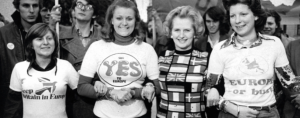
Those on the No side included Enoch Powell, Tony Benn, Michael foot, and the Rev Ian Paisley! Wilson, Heath, Jenkins, Whitelaw, and Jeremy Thorpe were all on the yes side. The British people voted to remain by a 2 to one majority, 67.2% yes, 32.8% no. The only parts of the British Isles which voted no Shetland and the Western Isles.
I found this chapter fascinating because it clearly demonstrates that the British people were duped into staying in what they were told was just a ‘common market’ when Edward Heath and Harold Wilson, both knew that it was to be come the European Union. In all the hysteria from our current politicians, including the modern SNP (the old SNP was totally against the EU – imagine how they would feel about their successors standing with Mrs Thatcher and being fanatical about what Mrs T called ‘Thatcherism in Europe – the Single Market!).) about lying and financial misuse, I wonder if any of them will stop to reflect that we were all lied to in the First Referendum and that the scale of financial misconduct then was at a level which far outweighs anything alleged in the second referendum.
“The trouble was that very few others are doing any serious thinking. Britain was sleepwalking into an entirely new situation, the nature of which her people could not yet begin to comprehend.”
This article from The New Statesmen agrees with the main facts of The Great Deception although from a different perspective.
The Great Deception 9 – The Politicians Deceit and the Fishermen Betrayed