


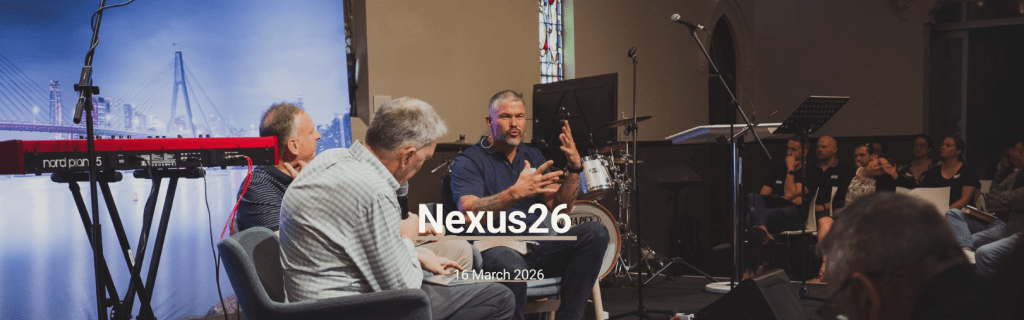
Letter from Australia 124 – A Disappointing Conference on Evangelism.
Dear Brothers and Sisters,
This week I was at a conference on evangelism. I was really looking forward to it, but I ended up being frustrated and really disappointed. Let me explain why
I came to Australia to get involved in evangelism. Evangelism being the communication of the good news of Christ to people who desperately need Him. I wanted to learn both how to do it better, and also to share in actually doing it.
Despite the change in employment from City Bible Forum to Evangelism and New Churches (of Sydney Anglicans) and now to Scots Kirk Presbyterian – my aim and heart has always remained the same. So, I was delighted to read that the excellent Nexus conference in Sydney was going to focus on evangelism. I signed up immediately!
On Sunday evening we drove down to Sydney and Monday I headed off with a degree of anticipation to the Village Church, Annandale.
To begin with we were given some of the bare statistics about the decline in Sydney Anglican churches. The number of large churches has dropped from 21 to 10. 63% of Sydney Anglican churches have decreased, and even those what are not declining are growing primarily because of transfer growth. These figures are unquestionably accurate as Sydney Anglicans are very good at figures and have a mine of data information.
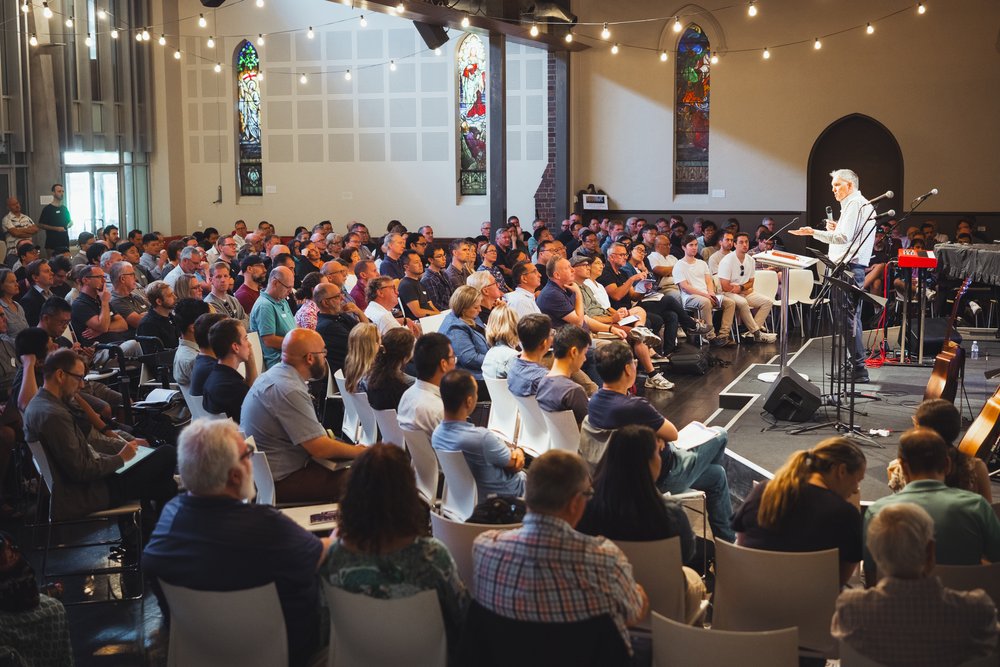
This is an important issue – not just for Sydney Anglicans – but for the wider church in Australia – including the Presbyterians – because Sydney Anglicans have been a dominant and influential force in the Australian church for many years. Their methodology, ecclesiology and theology dominate the evangelical scene in Australia – and is a big influence on many other parts of the world – including the UK, Africa and the USA.
The speakers at the Nexus conference showed why. Chris Braga and Phil Colgan are two excellent pastors who spoke well. Dave Jensen is probably the best-known Australian evangelist working in Australia, and is certainly one of the best speakers. He has a sharp mind and a Godly passion. Dominic Steele, pastor of the Village Church, in whose church Nexus is held has a great podcast – The Pastor’s Heart – which really does give insight into the world of Sydney Anglicanism.
So, given all of that – why was I so disappointed and frustrated that I actually left early? I had paid for the whole day and as a Scotsman, I believe in getting value for money – so why miss the lunch and the afternoon session? Because I just found it too painful – and by the time we got the end of the Q and A session I realised that this was not my world, and I had nothing to say into it. Given that I had worked in this world for four years this was a profoundly disappointing experience.
I have wrestled with this over the past 24 hours – including a restless night. Trying to work out why – and what was wrong with me! I write this not in order to attack people – nor even to just engage in self-reflection – but I hope to help myself and others think through some of the issues raised.
There was much that Braga, Colgan and Jensen said that was helpful and instructive. But overall, I felt that the message was like that of a defeated political party which says, “The people are not getting our message, we just need to repackage it and carry on doing the same thing”. Let me just list some of the points I struggled with. (By the way I confess I may be wrong – this was part of my frustration and sorrow – what if I am wrong? What if these brothers have really got it right and their model is the one we should all be following?). But let’s look at some of the issues where I felt there should have been at least some discussion.
- Ministry is tough. Yes, it is. But we need to ask why? And we need to ask why so many ministers crash and burn – and why there appears to be a relative reluctance for pastors to become senior rectors in the Anglican system.
- Never let evangelists be in charge of the church – Why? The implication seemed to be that evangelists would be so concerned to get people in by any means that they would let theology, or ecclesiology slip. Yet it was Paul who stated that he became all things to all people that he might win some (1 Corinthians 9:20) ….and it was to Timothy, the pastor, that Paul said he should do the work of an evangelist in order to fulfill his ministry ((1 Timothy 4:5). I realise that in the context of the ecclesiology of Sydney Anglicanism this comment makes sense – but I just think that it is the ecclesiology that is wrong and does not reflect the biblical view that evangelism, church and theology go together. This was an especially poignant point to me because I once had a senior Christian argue against me being called to a particular charge because I was an evangelist and the last thing that the church needs is a minister who is an evangelist. I have also heard pastors say that evangelism wasn’t their thing and therefore they didn’t want to do it. How can you be a pastor with that attitude?
- In order to do effective evangelism, we need proclaimers rather than apologists? Churches with most conversions see minimal apologetic detours. It’s almost become a cardinal doctrine amongst Sydney Anglicans that apologetics is somehow a hinderance to evangelism. The irony is that one of the people most responsible for this doctrine, Philip Jenson, is himself one of the best apologists in the business! Again I think the problem here is a misunderstanding of what apologetics is. Almost all of the early church fathers would have regarded themselves as apologists for the gospel. And I am certain that Peter, Paul and the other apostles did so as well. They debated from house to house, in the synagogues, the temples and the marketplaces. We are always to be prepared to give an answer to everyone who asks us for the reason for the hope that we have (1 Peter 3:15). I don’t think that Peter meant we had to learn a formula from a booklet that we could repeat ad nauseum to all and sundry! I don’t understand how you can be a proclaimer without being an apologist, or how you can claim to be an apologist without proclaiming!
- I wanted to point out what Tim Keller said when asked what he would change in his 30-year-old self. His reply was that he would not teach his congregation an evangelism programme – instead he would ask what three questions they were most scared of being asked. I wanted to point it out – but for some in Sydney Anglican circles citing Tim Keller is enough to make you questionable – to say the least. And to be questionable in this context is the equivalent of being thrust into outer darkness!
- Focus on the People Most Likely to be Converted –
I understood what was being said here – and to some extent can appreciate it. But the reality is that conversion is a sovereign work of the Holy Spirit, and he doesn’t tell us who is going to be converted – nor how. I don’t think we should second guess Him. It may not be the way that advertisers do it – but I honestly believe that the church should never target particular groups – especially based on the perception that they are the most likely ones to be converted. We don’t know. I suspect that in this context the speaker was talking about the methodology used – that as he claimed, most adult converts are converted in evangelistic courses – but even given that questionable premise – I am not convinced that it is right to us to restrict the Holy Spirit to the way that our focus groups say He will work!
- The Mission Pathway is Contact, Connect, Conversion and Church Life.
I am not convinced that there is a ‘mission pathway’ but I agree there are basic principles. In terms of what we can do I would agree that we can contact, and connect. But we cannot convert – nor should we seek to do so. I would replace ‘conversion’ with ‘communication’. Our aim is simply to present Christ, in the power of the Spirit, knowing that the Lord’s Word will not return to him empty.
- The most likely places for adults to be converted is on courses – and also personal one to one evangelism.
This is often stated – but I would love to see the evidence for it. I once spoke to an Anglican church leader who told me that he thought the purpose of his Sunday services, as regards non-Christians, was to get them into one of his courses. That seems to me the complete reverse of what should be.
This also seems such a narrow and mechanistic methodology. What about the foolishness of preaching? The Holy Spirit? Hospitality? Prayer? The Internet? Books? Mercy ministries? The arts….?
- What do we want people to experience? That is a great question. My answer would be that I want them to experience Christ. And I would argue that one of the best, if not the best, way to get that is through something that Sydney Anglicans deny exists – public worship. I heard recently of a pastor telling his worship leaders that they should not begin the service by saying let us worship God – because that is not what we are doing – except insofar as everything we do is worship. The loss of the concept of public worship is as big a disaster for the church as is the loss of the Lord’s Day. And it is removing one of the key components of evangelism – the opportunity to ‘taste and see that God is good’, and to come into a service of worship where you so experience the presence of God that you ‘fall down and worship God, exclaiming, ‘God is really among you’” (1 Corinthians 14:25). In rejecting sacramentalism and an over realised religious liturgy, Sydney Anglicans have thrown out the baby with the bathwater by denying public worship.
- If we change our practice, we will see people become Christians.
If only it were that simple! Doubtless we need reformation. But I suspect it needs to be a lot more radical than a change of programme – and without renewal and revival it will only be rearranging deck chairs on the Titanic.
- Evangelism is easy if you have the courage.
In one sense evangelism is easy – if by evangelism you simply mean telling people the good news about Jesus. And it does take courage. But it also takes wisdom, understanding, love, prayer etc. And evangelism is the most difficult thing in the world. This is bringing the spiritually dead to life – and that is even more miraculous than the raising of Lazarus! (John 14:12). In order to present everyone fully mature in Christ we have to ‘strenuously contend with all the energy Christ so powerfully works in us’ (Colossians 1:29). It’s a battle. It’s spiritual warfare. It involves suffering and sacrifice. It means dealing with ‘hollow and deceptive philosophies’ (Colossians 2:8). If people believe that evangelism is easy if only you have the courage, then they will end up being disappointed, frustrated and disengaged.
- There are no blockages out there – at least none that have not existed before.
It is of course true, and a truism, that there is nothing new under the sun (Ecclesiastes 1:9). But it is also true that there are differences in culture and society over time – some of which result in increased blockages to the Gospel. We are to be like the men of Issachar who understand the times (1 Chronicles 12:32). In terms of Australia there are real blockages to the Gospel (apart from the fact that people are dead in sins and trespasses!). Materialism, ignorance, pluralism, hypocrisy in the church etc have all existed before – but they may do so to different degrees. If I wish to reach the Chinese community then one of the blockages may be that of language. Surely learning Mandarin might be a good way to communicate the Gospel? And what about the ‘defeater beliefs’ of our culture? Are they not often different than those of 50 years ago?
- You don’t need to start further back…just start with the Gospel
This sounds as though it should be right. But it’s not biblical – at least not if you read through how the early church evangelised in the book of Acts. They often did start further back – take for example Paul in Acts 17. He started way back with the idolatry and confusion of the Greek gods in Athens!
- We don’t need to be experts in their worldview – we need to be experts in the Gospel –
I am not sure what being an ‘expert in the Gospel’ means. I realise it is a rhetorical flourish which is basically saying that to communicate the Gospel all we need is the Gospel. But that is demonstrably not true. We need to know the best way to communicate. And therefore we should seek to understand and know the people we are trying to communicate with. For example, I once found myself in a lot of trouble because I asked Muslims in a questionnaire ‘do you think Jesus is the Son of God’? As someone with a Gospel understanding of the Trinity, I thought that was a straightforward question. But instead, they heard something completely different – so grotesque and blasphemous I won’t write it down! I was saying one Gospel truth – they were hearing something else. We don’t need to be experts – but we do need to have some knowledge. Just because God can speak through the mouth of a donkey does not mean that we should all behave like donkeys!
- We are not in a post Christian age because we were never in a Christian age.
This again is one of those truisms that works because it is at least partially true. Australia was never a purely Christian country. But it is ahistorical nonsense to imply that there was no Christian age. When the Macedonian cry came (Acts 16) to Paul and as a result the Gospel went West into Europe it was one of the key events in world history. As a result Europe eventually became Christian Europe. You have to have a particular form of pietism to deny that historical fact. Furthermore, when the first fleet came from the UK to Australia it did as coming from a nation which was largely founded upon Christianity – and it brought those Christian values into the founding of the new nation of Australia. Yes – there was a Christian age – much of the fruit of which still remains. But as the root is being, or has been destroyed – that fruit too will eventually rot. We are either in, or moving towards a post-Christian age. To fail to recognise that is a major weakness in some of the Church – and will hinder our evangelism.
- The Christian worldview doesn’t make sense unless you believe that Jesus died for your sins –
The speaker then went on to cite Acts 17 as an example where Paul just gave an illustration at the beginning and then a straight gospel presentation. The only problem with that somewhat limited analyses is that Acts 17 doesn’t mention Jesus dying for our sins. Does that mean Paul’s Gospel presentation was inadequate?
Conclusion
Why did I not make these criticisms within the conference? Because despite the self-description of this being a place where straight talking could be done – it just isn’t. I suspect we all live in different bubbles – but when your bubble is a comfortable one, and a relatively big one, then you tend not to see beyond it – other than at a very superficial level. After all you don’t need anyone else. I did try to raise these issues when I worked for Sydney Anglicans – but as one senior figure told me – every time you raised your head we squashed you like a gnat (or wee flea)!
Much of Sydney is a bubble in Australia. And much of Sydney Anglicanism is a bubble within that bubble. Anyone who threatens to prick the bubble will not last long. I did not want to stand up in a conference where I didn’t belong and say things which no one wanted to hear. Being a Jeremiah only really works if you are Jeremiah – and God has called you to that.
My view is that this conference ended up being just a call to repackage Sydney Anglicanism so that it was a bit more palatable to the people who are already within its orbit. It is the same stuff over and over again. But what if it is not just the packaging that is wrong?
The conference had the subtitle “God is not finished with Sydney”. I suspect that is true – but that does not mean He is not finished with Sydney Anglicans. Sometimes the candlestick is removed (as has happened to the Church of Scotland). And I would not be certain that God is not finished with Sydney. Or at least it may be that first He will judge the city for its pride, wealth and hubris; before He moves in revival and renewal.
Despite all of the above I do hope that the rest of the day went well. I also hope and pray that the Lord is not finished with Sydney Anglicans and that there will be renewal and revival amongst the brothers and sisters there. I give thanks for the ministry and work of Chris Braga, Dominic Steele, Phil Colgan and Dave Jensen. We need many more like them….and they need to escape the straitjacket that Sydney Anglicanism imposes upon them!
Be interested to know your thoughts….and to be corrected…iron sharpens iron….
Yours in Christ
David
PS. I have been asked to clarify something – was I making any kind of comparison with NSW Presbyterians? Not at all. We are in as desperate a state – if not worse. I suspect we too are at a crossroads – we will see in the next couple of years which direction we will go….I also don’t think that the answer is either Presbyterian or Anglican, or indeed any other denomination…somehow we need to all swallow our pride and genuinely work together…
Closing the Gap – A Better Way to Connect Bible and Practice – Regulative or Normative?