

This weeks column in Australian Presbyterian looks at the current trend for ‘reset’ and, using Donald Macleod’s Therefore the Truth I Speak shows what the church needs most. You can read the original here…
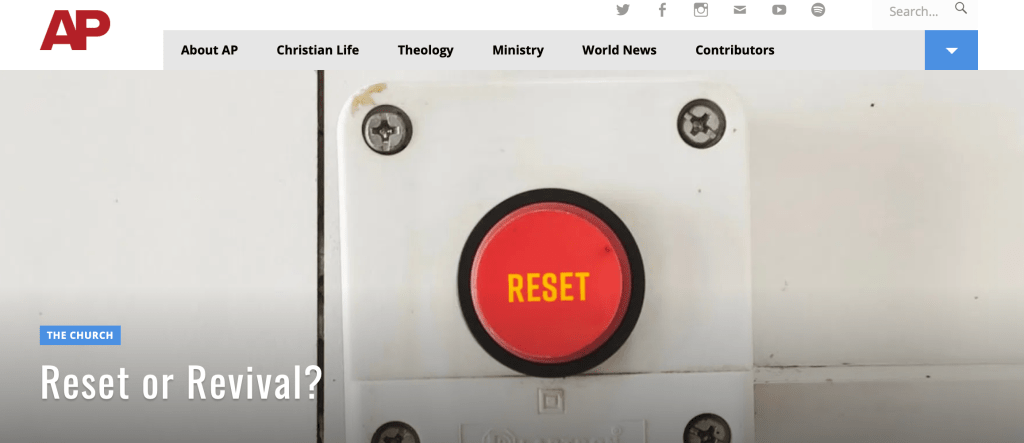

Everyone is talking about it – the UN, the politicians, the environmentalists, the media. Even the church wants in on the act. 2020 has been a pretty horrible year but, Hallelugnosis (praise the science)! Now we have a vaccine and soon everything will be back to normal. Or will it? Will there be a new normal? What about the subject on all the elite’s lips – Reset! How is the time to reset the planet, our countries, our companies, our churches and even ourselves. That’s all we need to do.
Except reset won’t work. It would be like restarting a computer which has a bug in so deep that no amount of switching off and on is going to work. The world does not have a temporary glitch – it has a permanent problem, one which ultimately science cannot solve. It has ever been thus. Over 2000 years ago the Lord sent us The Way – and ever since then humanity has found that Christ is the deepest answer for our deepest problems. What we need is not a reset of society, but a revival of the Church.
“Can a congregation or denomination reach a point where it is so spiritually dead that there can be no hope of reviving it?


I keep reading and hearing of new strategies, programmes, training and ‘reset’ within the church. But what we really need is new spiritual blood. What the society of the church needs is new spiritual immigrants – those who come with fresh ideas, new enthusiasm and the charismata that God has given to them. As Macleod says: “The truth is not so much that the revival of the existing membership produces the converts, but that the gift of new converts revives the existing membership. This is what we pray for when we pray for revival: fresh, young, spiritual life and love. And this is what drives all authentic Christian ministry: the desire of saving souls and leading hundreds, if not thousands, into the kingdom”. How authentic are we?
Revival is a sovereign work of the Spirit of God – not a campaign or strategy organised by a committee of the church, or one instigated by a particularly gifted individual. No man can start a revival. And no man can stop it. In speaking of where the 18th Century Scottish revivals took place Macleod points out that the Spirit moved where he pleases, not where we plan. That does not mean we should not plan, but it does mean we should make our plans in dependence, humility and weakness. “Many are the plans in a person’s heart, but it is the Lord’s purpose that prevails” (Proverbs 19:21).
Macleod argues: “Anyone organising a modern evangelistic campaign would choose a university city, or a great cosmopolitan hub, but God chose hamlets. Ayr was not a great city, neither were Irvine, Stewarton, Nigg or Carloway, and neither was Northampton in New England.” I understand the significance and reasons behind focusing outreach and major efforts in Sydney, Melbourne, Brisbane, Adelaide and Perth – but we should not be surprised if God works first in Orange, Bendigo, Rockingham, Wyndham or Bundaberg!
“They believed these truths with all their hearts, and they preached them with all their might, and they yearned for an ever deeper understanding of them.
Although we cannot replicate or re-create the revivals of the past, we can learn from them. Those involved were all different, but they all had prayer, preaching and passion in common. John Welsh of Ayr was a man of deep prayer whose wife found him one night on his knees praying “Lord, wilt thou not give me Scotland?” John Knox cried out to God “Give me Scotland or I die”. Who is crying out “Lord, give me Australia or I die?” Macleod also points out something that makes much church leadership today nervous. “Along with these labours went a refusal to be bound by caution, convention, or by the argument, ‘We never did that before.”. He also points out that these men preached theology. “They believed these truths with all their hearts, and they preached them with all their might, and they yearned for an ever deeper understanding of them.” Is it not the case that our sermons are often well presented but ultimately shallow and somewhat superficial cliched lectures or pep talks?
None of us are fit for these things. In a most controversial but I think beneficial passage Macleod shows that ‘reset’ for people is not enough. New life is what is needed – even (especially?) in our churches. “Awakening means persuading thousands of Christians that they are not Christians at all. This is not simply a matter of theological illiteracy or Christians living in an open and impenitent defiance of the Christian ethic……it is something much more fundamental. Many in the churches have had no experience of the emotional and affective side of the Christian faith”. No bad conscience, no grief, shame or fear of sin. They think sin died with the Victorians or is something that other people do. As a result, they don’t experience the joy of burdens being lifted at Calvary. They know nothing of the ‘unspeakable joy, full of glory” (1 Peter 1:8). I sometimes wonder if we are so scared of the excesses of some of the charismatic movement that we have forgotten the emotional, affective side of Christianity. Is it wrong to want a ‘felt’ Christ?
This Christmas and New Year reflect on the words with which Macleod closes the chapter:
“Their (our?) one great characteristic is complacency: complacency in the church itself; dead branches, lifeless members. What these need is not awakening, but resurrection (Ephesians 2:5). Surely, then, there is nothing we can do. No, but there is something we are commanded to do. We have to proclaim, even within the walls of our churches, ‘You must be born again,’ praying that God will use our human word, spoken with ‘poor, lisping, stammering tongues, as His very own word, and cause the dry, skeletal bones to live. (Ezekiel 37:3).”
Only then will we cry from the heart “Hallelujah”!